Canva vs Adobe vs AI Tools: Complete Breakdown
Choosing the right design tool depends on your goals, experience, and budget. Whether you're a beginner, a professional designer, or a busy entrepreneur, understanding the strengths and weaknesses of Canva, Adobe, and AI tools can help you make better decisions. Here's a quick summary:
- Canva: Simple, user-friendly, and great for quick designs. Ideal for small businesses, social media managers, and beginners. Offers templates, drag-and-drop features, and collaboration tools. Affordable, but limited for advanced design needs.
- Adobe: Professional-grade tools with unmatched customization. Best for experienced designers and agencies working on high-quality projects. Requires time to learn and comes with higher costs.
- AI Tools: Fast and automated design options using text prompts. Perfect for generating content at scale, especially for social media. Affordable and easy to use, but lacks originality and deep customization.
Quick Comparison
| Platform | Best For | Strengths | Weaknesses |
|---|---|---|---|
| Canva | Beginners, small teams | Easy to use, templates, affordable | Limited customization, basic design features |
| Adobe | Professionals, agencies | Advanced tools, total control | Steep learning curve, expensive |
| AI Tools | Entrepreneurs, content creators | Fast, automated, scalable | Generic designs, limited creativity |
Each tool has its place. Canva is great for quick, polished designs. Adobe excels in detailed, professional work. AI tools save time with automation. Combine them to match your needs and workflow.
Making The Same Design in Adobe vs Canva
1. Canva
Canva stands out as a user-friendly platform designed for creating professional-quality graphics without requiring extensive design skills. Its simplicity and versatility make it a go-to tool for a wide range of content creation needs.
Features
Canva's appeal lies in its intuitive drag-and-drop interface and a massive library of templates tailored for social media, presentations, and print materials. Users can easily browse through stock photos, icons, illustrations, and fonts using robust search tools.
One of its standout features is the Brand Kit, which allows businesses to upload logos, define brand colors, and save custom fonts to ensure consistent branding. Collaboration is seamless, with tools that enable teams to work on projects simultaneously and leave real-time comments.
Other handy tools include Magic Resize, which optimizes designs for various social media formats, and a Background Remover that simplifies photo editing. Canva even offers basic video editing capabilities, such as animations, transitions, and music integration. These features, combined with tools for repetitive tasks, make Canva a versatile platform for creators.
Automation
Canva takes productivity a step further with automation. Its content planner lets users schedule posts directly to popular social media platforms. The platform also uses AI to suggest design ideas and create multiple variations. For projects like catalogs or event invitations, bulk creation tools save time by generating multiple versions efficiently.
Pricing
Canva offers flexible pricing options through its freemium model. The free version includes access to templates and basic editing tools but limits premium features and storage. Upgrading to a Pro subscription unlocks advanced editing tools, additional storage, and removes watermarks. For teams, Canva provides plans with collaboration features and administrative controls to streamline brand management.
Strengths and Limitations
Canva's ease of use and quick turnaround make it an excellent choice for small businesses, social media managers, and content creators. Its extensive template library and frequent updates ensure the platform stays relevant, while its collaboration tools help teams maintain consistent branding.
However, for users with advanced design needs, Canva's template-driven approach can feel limiting. Professional designers might find its typography options and export formats insufficient for certain print requirements. Additionally, while Canva's AI features are convenient, they don't match the capabilities of specialized tools for creating complex or highly original designs. These factors highlight Canva's strengths while setting the stage to explore other tools.
2. Adobe
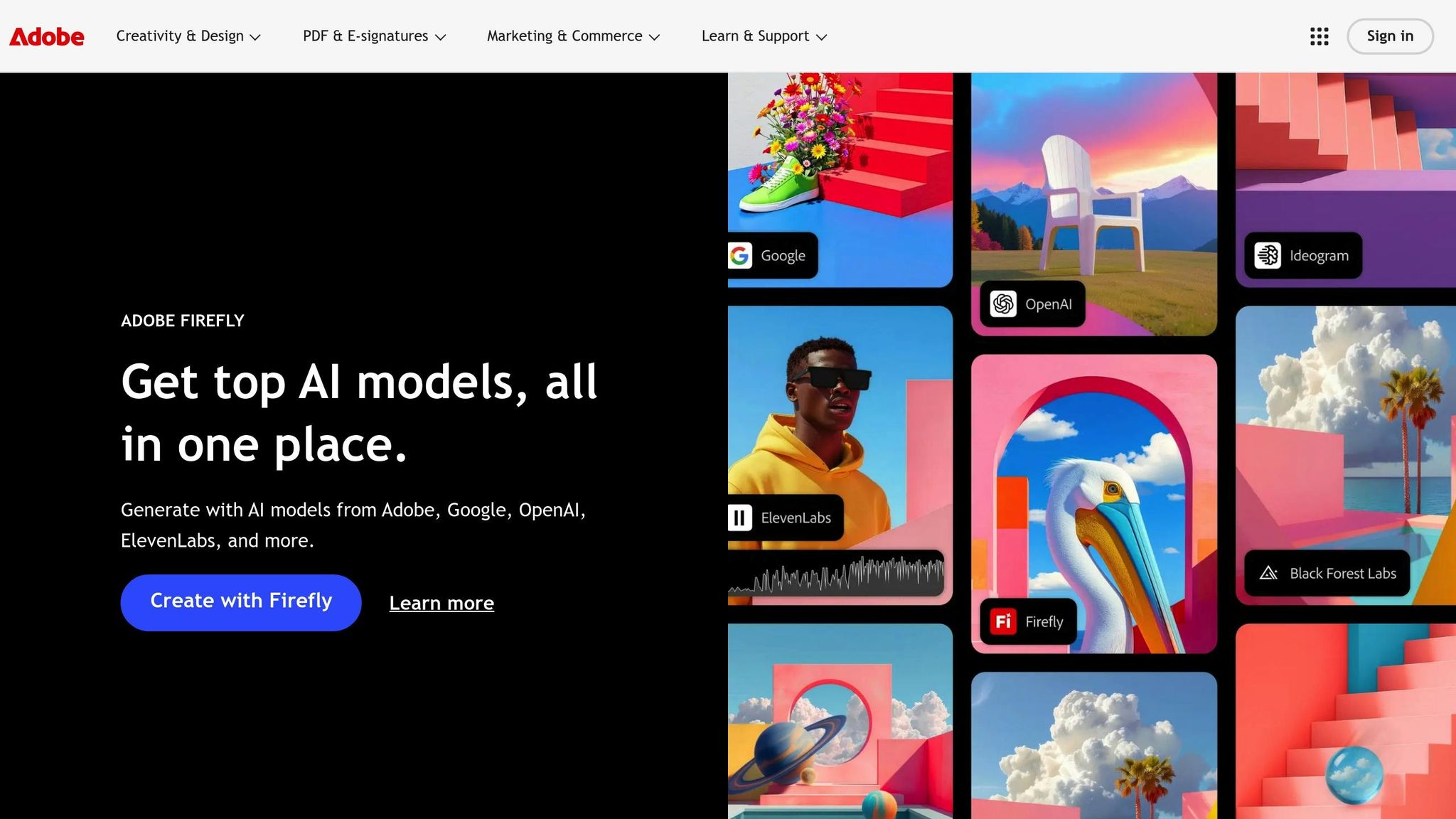
Adobe takes a professional approach to creativity, offering a suite of tools that deliver precision and versatility. Adobe Creative Cloud includes over 20 applications designed for creating print, digital, and video content.
Features
Adobe's key applications - Photoshop, Illustrator, Premiere Pro, and After Effects - work together seamlessly, ensuring high-quality results across projects.
The Creative Cloud Libraries feature allows users to share assets like colors and fonts across different apps, streamlining workflows. Additionally, Adobe Stock offers access to millions of premium images, videos, and graphics directly within the platform.
Generative AI plays a big role in Adobe’s offerings. It’s widely used for editing, creating assets, and brainstorming ideas. In fact, 86% of creators report using these features, with many experiencing notable improvements in efficiency.
Automation
Adobe uses AI-powered tools to automate repetitive tasks, saving creators time and effort. Features like Content-Aware Fill can remove unwanted objects from images, while Auto Reframe optimizes video ratios for different platforms. With mobile-first workflows becoming more common, 72% of creators now produce content on mobile devices, and 75% plan to increase mobile content creation in the next year.
Pricing
Adobe operates on a subscription basis, offering flexibility through multiple tiers. Users can opt for single-app subscriptions or access the full Creative Cloud suite. Students and educators can take advantage of discounted rates, and annual plans typically offer lower monthly costs compared to month-to-month billing. While the subscription model ensures access to updates and cloud services, it can represent a significant ongoing expense.
Strengths and Limitations
Adobe shines in its ability to deliver professional-grade tools with regular updates that incorporate advanced AI and machine learning capabilities. Its cloud infrastructure supports smooth collaboration, and the company has made efforts to promote equity and inclusivity. For example, Adobe is working to reduce AI bias, improve representation in stock imagery, and design tools that are accessible for neurodivergent creators.
However, there are challenges. The steep learning curve, partly due to frequent updates, can be intimidating for new users. Adobe’s tools also demand high-performance hardware, which can be a barrier for some. Cost is another concern - 38% of creators cite high expenses as a hurdle for adopting generative AI tools, while 34% worry about inconsistent output quality. Additionally, reliance on internet connectivity for cloud syncing and license verification can occasionally disrupt workflows.
Despite these hurdles, Adobe remains a key player in the creative industry, with 85% of creators agreeing that generative AI has positively influenced the creator economy.
sbb-itb-9f5fe42
3. AI Tools
AI tools are changing the way social media content is created, making it faster and easier to produce engaging posts. With automation and smart design features, these tools allow users to turn simple prompts into polished posts and carousels in just minutes. Let’s take a closer look at what makes these tools so effective, from their features to their pricing and usability.
Features
Modern AI tools come packed with templates, smart layouts, and customization options designed to simplify content creation. For example, you could input a prompt like, "Create a LinkedIn post about productivity tips," and the tool would generate several tailored options. These platforms also support multiple languages and adapt to your unique writing style over time. Plus, they make it easy to personalize posts by letting you upload your own images directly into the designs.
Automation
One of the standout benefits of AI tools is their ability to automatically adjust layouts for different platforms. Whether you’re creating an Instagram story or a LinkedIn banner, the tool ensures the dimensions are optimized - no manual adjustments needed. This automation saves time and speeds up the entire content creation process.
Pricing
AI tools typically use a freemium pricing model, making them accessible to a wide range of users. Basic features, like standard templates and simple design options, are often available for free. Paid plans, however, unlock more advanced features, including a larger library of templates, better text editing controls, multilingual support, and deeper customization options. For businesses, enterprise plans often include team collaboration tools and premium customer support, offering even more flexibility.
Strengths and Limitations
These tools shine when it comes to speed and simplicity. Even users with little to no design experience can create professional-looking social media content in no time. Their intuitive interfaces and automation features make them a cost-effective solution for small businesses and solo creators. That said, relying on pre-made templates can sometimes result in designs that feel a bit generic. And while automation is great for efficiency, it doesn’t always provide the level of fine-tuned customization needed to establish a truly unique brand identity.
Pros and Cons Comparison
Here’s a quick look at the strengths and weaknesses of each platform to help you decide which fits your needs best:
| Platform | Pros | Cons |
|---|---|---|
| Canva | • Easy-to-use drag-and-drop interface • Large library of templates for social media • Budget-friendly pricing options • Collaboration tools built in • No design skills required |
• Limited customization compared to advanced tools • Templates can feel generic • Lacks advanced design features • Free options may not maintain brand consistency • Export features are restricted in the free plan |
| Adobe | • Professional-level design capabilities • Full creative control and customization • Trusted by industry professionals • Advanced tools like vector editing and animations • Smooth integration across Adobe’s ecosystem |
• Steep learning curve for beginners • High subscription costs • Time-consuming design process • Requires prior design experience • Overkill for simple social media tasks |
| AI Tools | • Instant content creation from text prompts • Automatically optimized for multiple platforms • No design knowledge needed • Affordable freemium models • Continuously improving design capabilities • Supports multiple languages |
• Template-based designs can lack originality • Limited options for detailed customization • May struggle to reflect a brand’s unique identity • Relies on AI accuracy for suggestions • Offers less creative flexibility than manual design tools |
This table outlines the key differences, making it easier to align the platforms with your specific needs.
If you’re looking for something quick and affordable, Canva and AI tools are great options, with Canva offering a more hands-on approach and AI tools excelling in speed. For those who need professional-grade results and have the time to invest in learning, Adobe delivers unmatched customization and advanced features. It all comes down to balancing your budget, design experience, and how much time you’re willing to dedicate to the process.
Conclusion
Selecting the right design tool depends on your unique needs, budget, and level of design expertise. Each option caters to different users and goals, so understanding their strengths can help you make the best choice.
Canva is perfect for businesses and teams looking for quick, polished designs. Its templates and drag-and-drop interface make it easy to produce consistent results fast. This is especially helpful for teams that need to maintain brand consistency but don’t have professional design experience.
Adobe is the go-to for professional designers and agencies seeking complete creative control. If your projects require high-quality materials that work seamlessly across print and digital formats, Adobe's advanced features are worth the investment. While it has a steeper learning curve and higher cost, it’s ideal for businesses where top-tier design directly impacts revenue.
AI tools shine for entrepreneurs and busy professionals who need content quickly and at scale. These tools can generate multiple social media posts and design variations in no time. However, they’re best used as a starting point rather than a final solution, particularly for brands with strong and consistent visual identities.
Ultimately, your choice should hinge on three factors: time, design skills, and budget. If you’re short on time but need professional-looking results, AI tools offer a fast solution. For moderate design needs with hands-on control, Canva is a great middle ground. And if you require maximum flexibility and can invest in learning, Adobe provides unmatched creative possibilities.
In many cases, creators combine these tools effectively. AI tools can handle quick ideation, Canva simplifies everyday posts, and Adobe takes care of intricate, high-stakes campaigns. By leveraging the strengths of each, you can build a workflow that fits your needs perfectly.
FAQs
How do Canva’s collaboration tools compare to those offered by Adobe and AI platforms?
Canva shines when it comes to real-time collaboration, making it easy for team members to work on designs together. With just a shared link, users can collaborate seamlessly - leaving comments, tracking changes, and managing versions. For those on paid plans, Canva steps it up with features like team-only links, approval workflows, and detailed activity reports to keep everyone on the same page.
Adobe also offers collaboration tools, but they tend to be integrated into its larger ecosystem, which often requires a bit more technical know-how. Meanwhile, some AI-driven platforms prioritize automation over hands-on team collaboration, depending on the tool. Canva’s user-friendly design and simple collaboration options make it a go-to choice for small businesses and creators who value ease and efficiency.
How can AI tools be effectively integrated into a design workflow using Canva or Adobe?
Integrating AI tools into your design workflow with platforms like Canva or Adobe can bring a fresh level of efficiency and creativity to your projects. Canva, for instance, offers built-in AI features that simplify tasks like generating designs with quick prompts and automating repetitive processes, making the creative journey smoother. On the other hand, Adobe tools such as Photoshop and Illustrator use AI to power features like automatic background removal and content-aware adjustments, saving time without compromising quality.
To get the most out of these tools, let AI handle the tedious, time-consuming tasks so you can focus on refining your creative vision. Use AI-generated suggestions as a starting point to inspire fresh ideas, but always customize the results to ensure they align with your specific design objectives.
How can small businesses choose the best design tool for their needs and budget?
Small businesses need to begin by identifying their unique content creation needs. This means considering the types of designs they’ll be working on, their current level of design expertise, and how much time they can realistically spend learning to use a new tool. Prioritize tools that offer user-friendly interfaces, customizable design options, and automation features to streamline the process.
Budget is another critical factor. Compare pricing models to find one that works for your business. Whether it’s a subscription plan, a free trial, or a pay-as-you-go option, make sure it aligns with your financial plans. Lastly, think long-term. Choose a tool that can adapt as your business grows, ensuring it continues to meet your needs down the line.