Ultimate Guide to AI for Small Business Social Media

Managing social media can be overwhelming for small business owners, but AI tools are changing the game. These tools help automate tasks like creating posts, scheduling, analyzing performance, and even responding to customers. Businesses using AI save time, reduce costs, and improve engagement - all without needing a big marketing team.
Here’s what you’ll learn:
- How AI simplifies social media management by automating repetitive tasks.
- Tools that create captions, hashtags, and visuals while analyzing what works best.
- Strategies to align AI with your business goals and audience preferences.
- Tips for maintaining your brand’s voice and ensuring quality content.
- How to start small with affordable tools and scale as you grow.
Key takeaway: AI lets you focus on growing your business by handling the heavy lifting of social media, so you can post consistently, engage effectively, and drive results.
Powerful AI Social Media Strategy for Any Business 🤯
How AI Improves Social Media Management
Manual vs AI-Assisted Social Media Management Comparison
AI is changing the way small businesses handle social media by taking over repetitive tasks. Instead of spending hours crafting posts, scheduling them, and digging through performance data, AI tools handle these jobs, freeing up your time to focus on other priorities. Let’s dive into the specific ways AI can enhance your social media efforts.
What AI Can Do for Your Social Media
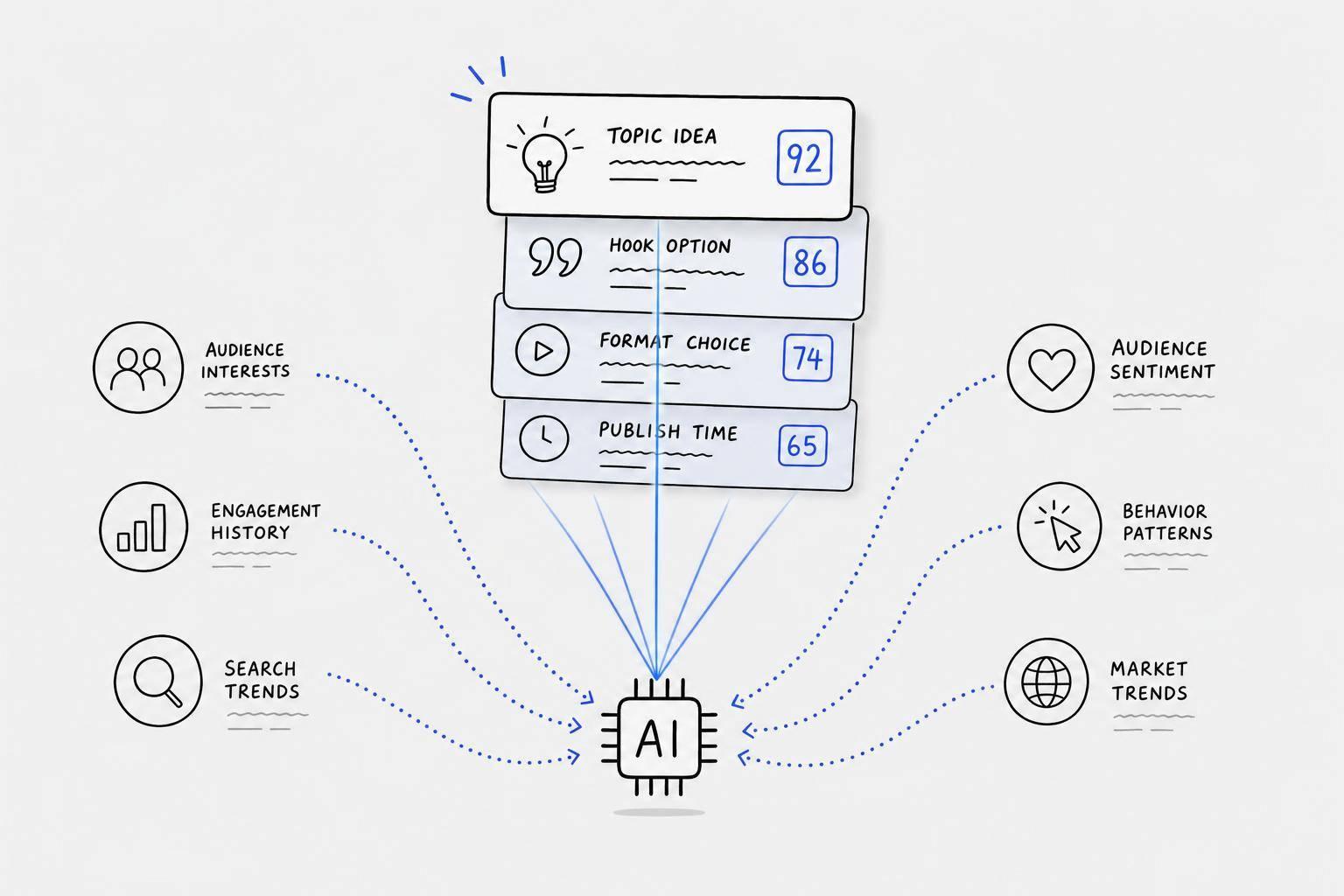
AI can streamline multiple aspects of managing your social media accounts. It can create captions, generate hashtags, and even develop visual content like images and video scripts. Plus, AI tools can schedule posts during peak engagement times, ensuring your content reaches the right audience when they’re most active.
But it doesn’t stop there. AI analyzes how your content performs, helping you understand what your audience likes and guiding your future strategy. On top of that, AI-powered chatbots can manage customer inquiries around the clock, so you’re always connected with potential customers - even outside business hours.
Benefits of AI for Small Businesses
For small businesses, AI tools can be a game-changer. They allow you to produce up to three times more content while slashing the effort required by 90%. Some companies have even seen engagement rates jump by 40% despite increasing their posting frequency.
Besides saving time, AI can significantly cut costs. By automating tasks, businesses can avoid hiring pricey agencies or full-time social media managers. Regular posting schedules, made possible by AI, help build trust with your audience, while the insights from AI analytics enable smarter content decisions. Looking ahead, companies using AI could see a 1.5 percentage point boost in labor productivity over the next decade.
Manual vs AI-Assisted Social Media Management
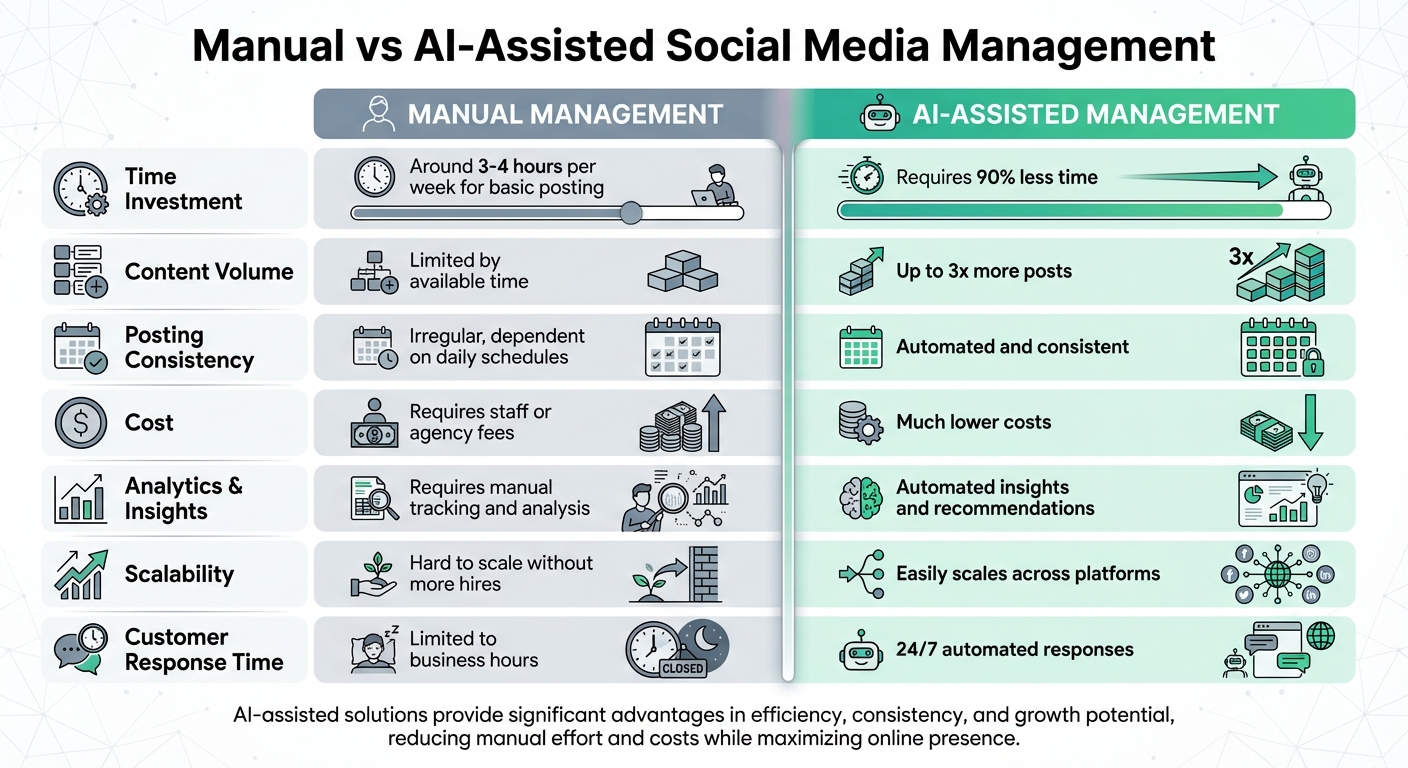
Here’s a side-by-side look at how manual social media management compares to using AI tools:
| Aspect | Manual Management | AI-Assisted Management |
|---|---|---|
| Time Investment | Around 3–4 hours per week for basic posting | Requires 90% less time |
| Content Volume | Limited by available time | Up to 3x more posts |
| Posting Consistency | Irregular, dependent on daily schedules | Automated and consistent |
| Cost | Requires staff or agency fees | Much lower costs |
| Analytics & Insights | Requires manual tracking and analysis | Automated insights and recommendations |
| Scalability | Hard to scale without more hires | Easily scales across platforms |
| Customer Response Time | Limited to business hours | 24/7 automated responses |
AI doesn’t just make social media management easier - it makes it smarter, faster, and more efficient.
Building Your AI-Driven Social Media Strategy
Creating an AI-driven social media strategy isn't about jumping on every trendy tool out there. Instead, it's about picking the tools that match your business goals, resonate with your audience, and fit your budget. Let’s break it down step by step.
Connecting AI to Your Business Goals
Start by setting clear, actionable goals. Are you looking to boost sales, bring in more leads, or increase foot traffic? Your AI strategy should directly support these objectives. For example, if you want to post more consistently, AI can help streamline your efforts. A great success story is a local restaurant that used AI to ramp up its posting from once a day to four times daily across three platforms. The result? A 150% jump in social media-driven reservations, all while cutting their weekly time commitment from three hours to just 45 minutes.
Choose tools that deliver measurable results. If content creation is your bottleneck, try AI writing assistants to speed up the process. Or, if you're losing potential customers due to unanswered inquiries, consider an AI chatbot. James, a barbershop owner, solved this exact issue by integrating an AI chat feature on his website to handle appointment bookings and questions, ensuring he no longer lost clients. Keep measurable targets in mind - like increasing posts by 50% or improving engagement by 20% - so you can track your progress.
Choosing Your Target Audience and Platforms
Focus on the platforms where your audience is already active. Instagram and Facebook are perfect for visually-driven businesses, YouTube is ideal for tutorials or product demos, TikTok appeals to younger audiences, and LinkedIn is a go-to for B2B professionals.
AI can help you dig deeper into your audience's behavior, analyzing data from social media, browsing habits, and even purchase patterns. This isn't just about knowing demographics - it’s about understanding what motivates your audience and when they’re most engaged online. AI can even fine-tune your posting schedule to hit those peak engagement times, keeping your followers engaged without overwhelming them. For instance, an e-commerce store that switched to a consistent, AI-driven posting schedule of three daily posts with personalized product recommendations saw a 75% increase in social commerce sales. Once you’ve nailed down your platforms and audience insights, the next step is to figure out how to allocate your AI budget.
Setting Your AI Budget
You don’t need to start big - begin with free tools or trial versions to see what works for your business. Options like ChatGPT's free plan, Canva's Magic Write, Copy.ai, and HubSpot's AI Social Media Post Generator are great starting points.
When you’re ready to invest, there are plenty of affordable options. For instance, Notion AI costs around $8–$10 per member per month. Start small by focusing on tools that save you the most time, like those for content creation on your primary platforms. Maria, a flower shop owner, cut her weekly social media planning from three hours to just 30 minutes using AI, giving her more time to focus on her business. Track your time savings and engagement metrics to measure your return on investment. As you see results, you can gradually increase your AI spending to scale your efforts further.
Creating Social Media Content with AI
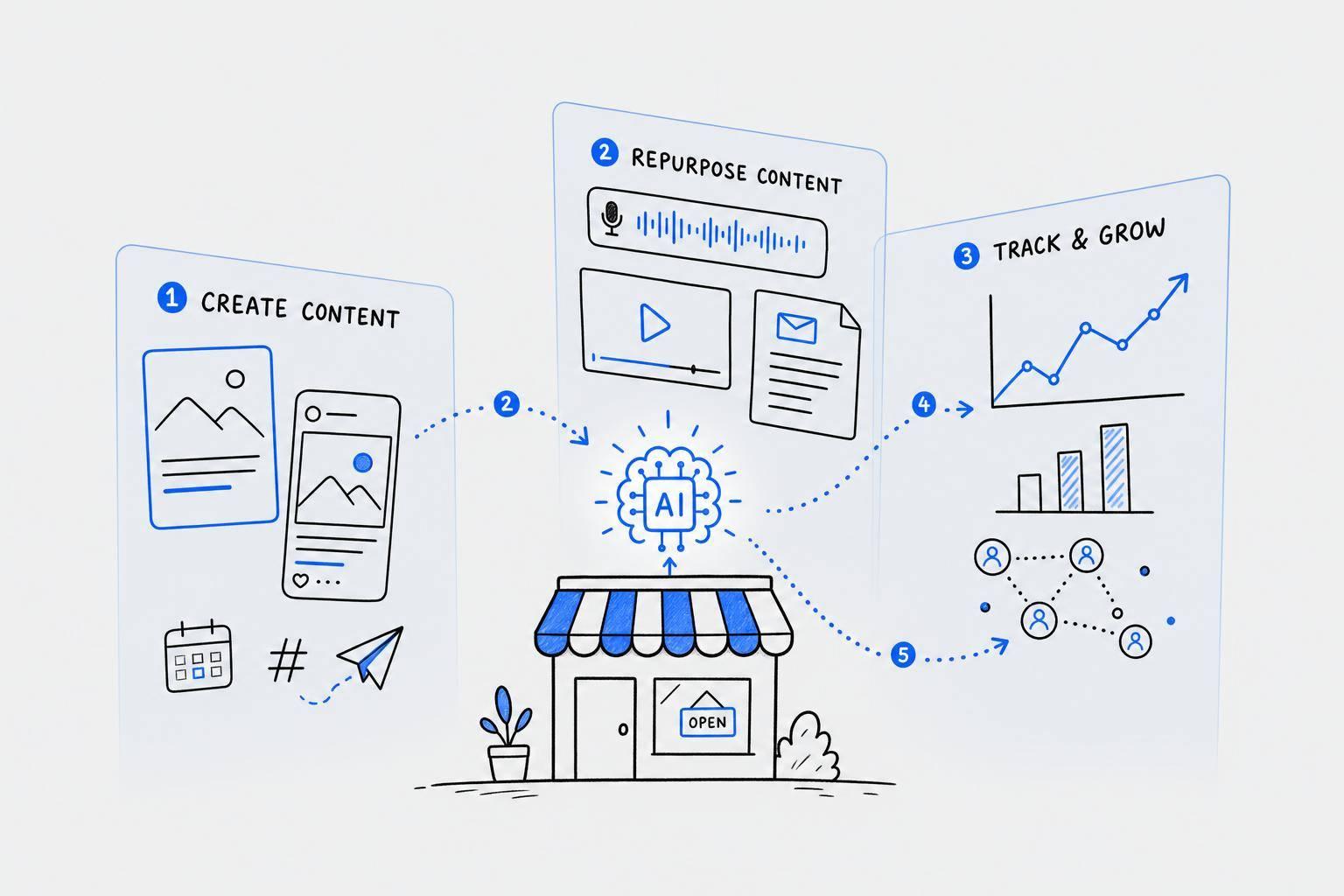
Once your strategy and budget are in place, let AI take the reins on content creation. Modern tools can handle everything from brainstorming and writing to localization and analytics, giving you more time to focus on big-picture goals like strategy and growth.
Using AI for Different Content Types
AI is a game-changer for repetitive tasks. It tailors content to fit the unique formats and audiences of different platforms. For example, it can transform long-form videos into short, engaging clips perfect for Instagram Reels or TikTok.
AI also adapts content formats with impressive precision. For captions, it drafts engaging text that aligns with your brand’s tone, whether you’re promoting a sale or sharing behind-the-scenes moments. For carousels, it organizes information into slides with eye-catching headlines. When it comes to short-form videos, AI generates concise, attention-grabbing scripts. These tools are designed to learn your brand voice, audience preferences, and compliance requirements. The result? Content that feels tailored to your business and resonates with your customers.
Keeping Your Brand Voice Consistent
Your brand voice is a reflection of your values, and maintaining it consistently across platforms can be challenging, especially as your content output scales.
AI tools are invaluable for keeping your voice on track as you grow. A strong approach often involves three key elements: voice classifiers that flag deviations in tone, rule-based guidelines for enforcing brand standards, and human editors who bring creativity and strategic nuance. Advanced marketing platforms take it further by learning from your past content, tracking edits, and analyzing performance. Over time, these systems improve at replicating your style, ensuring AI-generated content stays true to your brand. This consistency is essential as tools like Draft AI become part of your workflow.
How Draft AI Simplifies Content Creation
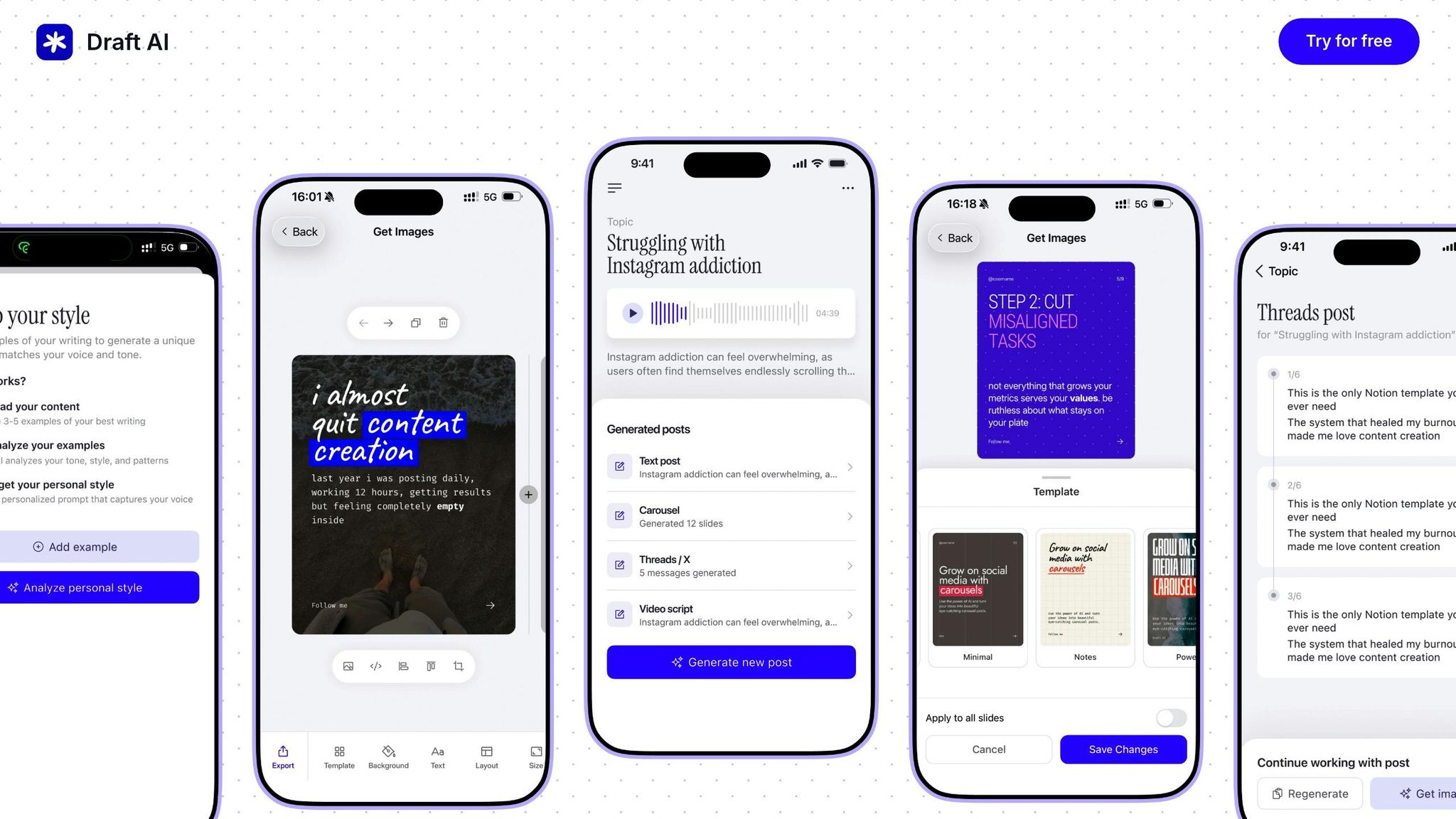
Draft AI removes the hassle of content creation by turning raw data - or even a simple voice message - into polished social media posts, carousels, or scripts in just minutes. Instead of staring at a blank screen, you can share your ideas or rough notes, and the tool does the rest.
With customizable templates that incorporate your fonts, colors, and images, Draft AI ensures your content looks professional and on-brand. It also supports multilingual translation, making it easy to adapt your message for different audiences. Plus, its AI-driven personal writing style feature learns your brand voice over time, so every post sounds like it came directly from you. Whether you’re crafting a quick Instagram caption or a detailed LinkedIn carousel, Draft AI handles the heavy lifting, freeing you to focus on running your business.
sbb-itb-9f5fe42
Scaling Your Social Media with AI Workflows
Scaling your social media efforts is all about working smarter, not harder. AI tools can handle repetitive tasks like idea generation, scheduling posts, and performance tracking. In fact, research indicates that automation via AI can reduce workloads by up to 80%. This frees up your time to focus on strategy and building stronger connections with your audience. The trick lies in creating a workflow that blends AI's efficiency with your personal touch. A structured approach ensures that every piece of content you produce serves a clear purpose and aligns with your goals.
Your Weekly AI Content Workflow
Kick off your week with AI-driven brainstorming. Use AI tools to scan trending topics, analyze what resonates with your audience, and identify content gaps. Don’t forget to incorporate customer questions and feedback into your planning. Once you’ve got a list of ideas, let AI assist with drafting captions, generating hashtags, and suggesting the best times to post based on audience activity.
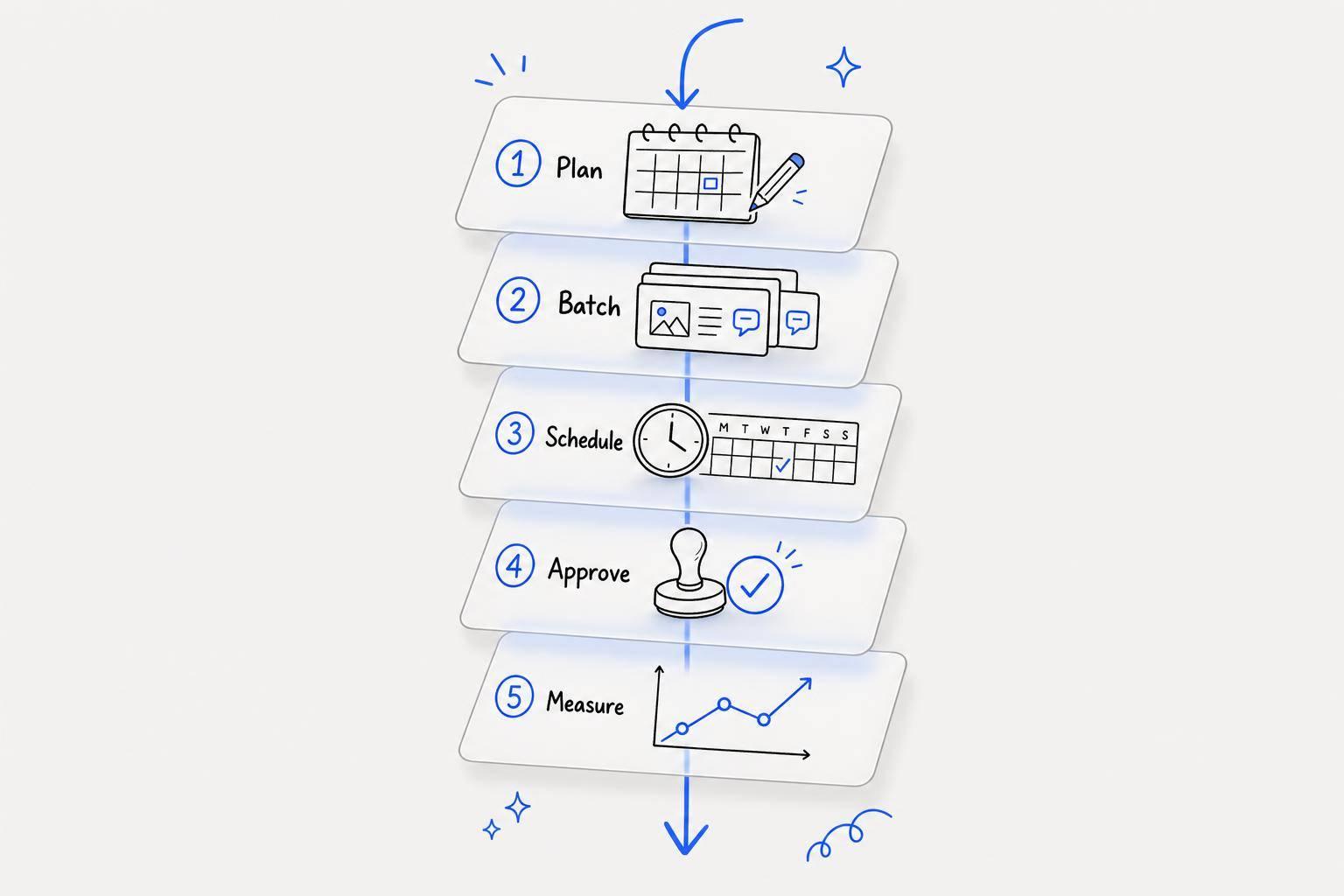
Here’s how a typical week might look:
- Monday morning: Use AI for social listening to identify trending discussions in your niche.
- Mid-week: Feed your raw ideas or voice notes into AI tools to create drafts tailored for each platform.
- Thursday: Review and refine the AI-generated content, adding your personal touch.
- Friday: Schedule posts for the upcoming week and set up automated responses for common customer queries.
This steady rhythm ensures a consistent content flow without the daily stress of scrambling for ideas, while also allowing you to refine your overall strategy.
Creating a Content Calendar with AI
AI takes the guesswork out of content calendar planning and turns it into a more strategic process. By entering your objectives, upcoming launches, and promotions into AI tools, you can get tailored posting schedules with recurring themes. For instance, if you’re rolling out a new service on March 15, 2026, AI can help you plan a lead-up campaign, complete with teasers, educational posts, and testimonials.
To keep your audience engaged, your calendar should feature a mix of content types. AI can help you strike the right balance between promotional posts, educational material, behind-the-scenes content, and user-generated submissions. You can even establish recurring themes like "Tip Tuesday" or "Feature Friday" to streamline the process. This kind of predictability not only simplifies your planning but also trains your audience to anticipate and engage with your posts.
Once your calendar is in place, maximize its impact by repurposing your top-performing content.
Repurposing Content with AI
Why let great content live only once? AI makes it easy to take your best-performing posts and reimagine them in new formats, ensuring you get the most value out of every piece. For example, a popular LinkedIn carousel highlighting your product features can be transformed into an Instagram Reel script, a series of Twitter threads, or even snippets for an email newsletter.
Here’s how it works: Start by identifying your top-performing content from the past month. Then, use AI to adapt it for different platforms. A blog post can be broken down into bite-sized social media tips. A customer testimonial video can be transcribed and turned into quote graphics. A webinar recording can become a series of short, captioned educational clips. This approach ensures your message reaches your audience wherever they are, in the format they prefer, while saving you time and effort.
Maintaining Quality and Authenticity
AI can speed up your workflows, but it can't replicate the personal touch that makes your brand stand out. The real challenge lies in using AI without losing the essence of your brand's voice. While AI can make content creation more efficient, it’s vital to ensure your content remains engaging and authentic. Audiences can quickly tell when something feels generic or impersonal. Think of AI as a helpful starting point, not the final product.
Avoiding Generic AI Content
Every piece of AI-generated content should go through a human review before it’s published. Start by ensuring the tone aligns with how you naturally communicate with your audience. Your content should reflect your brand’s personality - not a bland, corporate voice. Adding personal touches, like a customer’s name or a behind-the-scenes story, can turn a generic draft into something that feels genuine and relatable.
To make AI work better for your brand, train it to understand your unique style. Provide examples of your best-performing content to guide the AI. For instance, if you own a local bakery, your AI should learn that you prefer phrases like “fresh-baked” over “artisanal” or that you often mention your grandmother’s recipe when talking about your chocolate chip cookies. The more tailored examples you feed into the system, the more aligned the AI’s output will be with your brand voice. Always double-check facts, especially when it comes to details like dates, prices, or product descriptions. A quick review can save you from errors that might damage your credibility. While focusing on authenticity, it’s equally important to ensure your content complies with legal standards.
Legal and Ethical Guidelines
If you're using AI for social media, your content must meet the same legal and ethical standards as any other marketing material. Never let AI make claims about your products or services without verifying their accuracy and compliance with Federal Trade Commission (FTC) guidelines. For example, if the AI suggests a post promising “guaranteed results” or “scientifically proven” benefits, pause and ensure you can back up those statements.
Transparency matters. While you don’t need to label every post as AI-assisted, it’s essential to involve humans in the process. Customers value knowing there’s a real person behind your brand who genuinely cares about their needs. Be mindful of potential algorithmic bias, which could unintentionally reinforce stereotypes or exclude certain groups. Regularly review your content to ensure it represents your diverse audience fairly and avoids harmful assumptions. Also, prioritize data security by using AI tools that meet strict safety standards, and never input sensitive information without proper safeguards. Striking a balance between efficiency and responsibility is key to leveraging AI effectively.
Pros and Cons of AI in Social Media
AI offers numerous advantages, but it's important to be aware of its limitations to create a balanced strategy. Here’s a quick breakdown:
| Aspect | Benefits | Challenges |
|---|---|---|
| Speed & Efficiency | Automates repetitive tasks, saving hours each week | Requires time to set up and train your team on the tools |
| Cost | More affordable than hiring extra staff or agencies | Advanced features can be pricey for small teams |
| Content Quality | Quickly generates ideas and supports multiple languages | May produce generic content that needs careful editing and fact-checking |
| Scalability | Manages higher content volumes without extra time investment | Lacks emotional depth and creative flexibility compared to human input |
| Compliance | Provides built-in compliance checks to align with brand guidelines | Risk of plagiarism if content isn’t thoroughly reviewed |
"The future of AI is not about replacing humans, it's about augmenting human capabilities."
– Sundar Pichai, CEO, Google
Let AI handle the repetitive tasks so your team can focus on what truly matters - building relationships, crafting strategies, and creating content that highlights your brand’s unique identity. It’s not about achieving perfection; it’s about finding the right mix of efficiency and authenticity for your business.
Conclusion
AI gives you the freedom to focus on what sets your brand apart. Many marketers are already weaving AI tools into their strategies to boost engagement, tailor content to their audience, and keep track of performance metrics.
The key is to take things step by step. Start by identifying the platforms where your audience is most active and choose AI tools that address your biggest challenges. You don’t need to automate everything right away. Begin with repetitive tasks like scheduling posts or brainstorming content ideas, and expand your use of AI as you grow more comfortable with the technology.
Remember, your brand’s voice is essential. While AI can help with drafts, it’s up to you to add that personal touch. Share authentic stories, engage with comments directly, and let your audience see the human side of your business. AI can enhance your posting speed and consistency, but it’s your unique perspective that fosters trust and loyalty.
Use AI analytics to track performance and adjust your strategy based on what the data tells you. However, always let your understanding of your customers and your goals guide your decisions. A thoughtful mix of AI efficiency and human connection is what leads to lasting success on social media.
Ultimately, the future of social media for small businesses isn’t about having the flashiest tools - it’s about using AI wisely to build deeper connections with your audience while freeing up time for the work that truly matters.
FAQs
How can small businesses keep their brand voice consistent when using AI for social media?
To keep your brand voice consistent while leveraging AI, small businesses can use tools that offer customization options tailored to their specific style and tone. For instance, Draft AI lets users upload brand assets, define personal writing styles, and even adjust fonts and colors to match their branding.
Updating AI tools regularly with your style guide, past content, and key messaging ensures your output remains aligned with your brand's identity. Plus, taking the time to review AI-generated content before it goes live helps ensure it resonates with your brand's personality and values. By blending AI's speed with human oversight, small businesses can scale their social media efforts without compromising their unique voice.
What are some budget-friendly AI tools for small businesses to manage social media?
If you're a small business trying to improve your social media game without spending a fortune, there are plenty of budget-friendly AI tools to help you out. These tools can handle tasks like creating content, scheduling posts, and engaging with your audience - all while keeping costs low.
Take Draft AI, for instance. This tool makes it incredibly easy to craft professional social media posts, scripts, and carousels in just minutes. It comes loaded with features like pre-designed templates, options to customize fonts and colors, and even multilingual support. It's a solid choice for simplifying your content creation process. On the other hand, tools like Buffer and Publer are excellent for scheduling and managing posts, with plans starting at just $5 per month.
Using tools like these, small businesses can save time and money while ensuring their social media presence remains active and engaging.
How can AI help small businesses boost engagement on social media?
AI is transforming how small businesses approach social media by simplifying tasks and boosting content effectiveness. For instance, it can analyze audience behavior to pinpoint the best times to post, craft engaging and tailored content that connects with followers, and even handle responses using AI-driven chatbots.
On top of that, AI tools can track brand mentions, spot trending topics, and recommend fresh content ideas. This helps businesses stay in tune with their audience and maintain relevance. By tapping into these tools, small businesses can strengthen relationships, spark more interactions, and nurture lasting loyalty - all while cutting down on time and effort.