AI Writing Assistants: How They Improve Drafts

AI writing tools speed up content creation, boost productivity, and improve the quality of first drafts. They handle repetitive tasks like grammar checks, organize ideas into structured drafts, and refine tone and style for clarity. Research shows that using AI can reduce writing time by 40% and increase output quality by 18%. These tools also help businesses maintain brand consistency, support multilingual content, and cut costs compared to outsourcing. By automating the basics, writers can focus on strategy and creativity, making AI an essential tool for modern content creation.
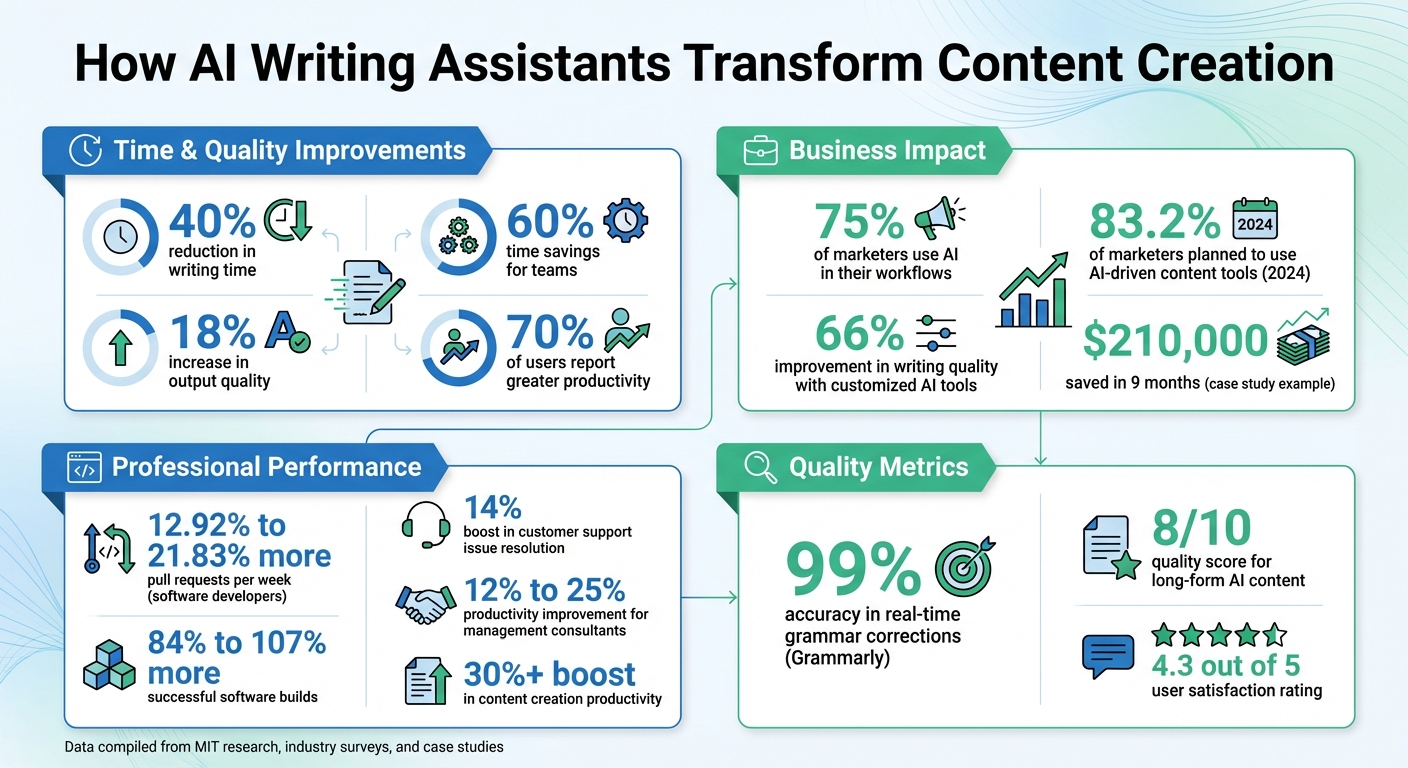
AI Writing Assistant Impact: Key Statistics on Productivity and Quality Improvements
7 AI-Powered Writing Tools That Actually Make a Difference
sbb-itb-9f5fe42
How AI Writing Assistants Improve First Drafts
AI writing tools have become game-changers for crafting strong first drafts, simplifying the process from brainstorming to completion. By handling foundational tasks, these tools help transform scattered ideas into structured drafts. From organizing outlines to generating full paragraphs based on prompts, AI eliminates much of the frustration that comes with starting from scratch. The result? Less time battling writer’s block and more time refining your message.
Automating Repetitive Writing Tasks
One of AI’s greatest strengths is taking over repetitive tasks that bog down the writing process. These tools handle grammar checks, spelling corrections, and sentence restructuring automatically. Some even go a step further with features like "Word Count Trimmers" to condense lengthy text and "Fluency Enhancers" to smooth out awkward phrasing. They can also simplify complex sentences, paraphrase text, or adapt content for different audiences.
This automation doesn’t just save time - it reduces mental strain. Writers can focus on creativity and strategy instead of getting stuck on the mechanics. As researchers Mina Lee et al. explain:
"A writing assistant is a computational system that assists users with improving the quality and effectiveness of their writing, from grammar and spelling checks to idea generation, text restructuring, and stylistic improvement."
- Mina Lee et al.
By taking care of the basics, AI tools pave the way for clearer, more polished drafts.
Improving Clarity and Writing Style
AI tools go beyond fixing errors - they refine the overall readability and tone of your writing. They can restructure entire paragraphs in seconds, offering concise and professional phrasing. Whether you need a confident, casual, or persuasive tone, these tools can adjust the language to fit your audience. They also simplify overly complex sentences, replace jargon with plain language, and flag repetitive phrases.
The impact is measurable. Grammarly, for instance, boasts 99% accuracy in real-time grammar and spelling corrections. Generative AI tools have been shown to boost content creation productivity by 30% or more. A 2024 Siege Media survey found that 83.2% of marketers planned to use AI-driven content tools, with over half citing AI’s ability to maintain a consistent brand voice as a key advantage.
Multilingual Support and Custom Writing Styles
AI writing assistants also excel in adapting drafts to specific needs, whether it’s matching a brand’s tone or localizing content for different markets. Features like "voice anchoring" allow AI tools to learn and replicate a writer’s unique style over time. This personalization not only enhances the final product but also helps writers feel more connected to their work. Studies show that incorporating personalized AI suggestions increases the use of AI-generated content by 5% and partially restores a writer’s sense of authorship.
For businesses, these tools can be tailored by uploading brand style guides and tone profiles, ensuring every draft aligns with company standards. Organizations using customized AI assistance report a 66% improvement in writing quality. Multilingual capabilities further extend these benefits, allowing content to adapt seamlessly to different languages and contexts. For instance, Content Strategist Lauren Reed saved her team $210,000 within nine months of implementing customized AI tools. As researcher Bohan Zhang observed:
"Style personalization partially restored ownership... and increased AI incorporation in text."
- Bohan Zhang, Researcher, arXiv:2601.10236
Research on AI Writing Assistants: Fewer Revisions and Higher Productivity
Studies on First Draft Quality
The data paints a clear picture. In July 2023, MIT researchers Shakked Noy and Whitney Zhang ran an online experiment with 453 college-educated professionals performing job-related writing tasks. Participants were incentivized to ensure effort, and the results were eye-opening: those using AI completed tasks 40% faster, and external evaluators rated their work 18% higher than the control group. Interestingly, individuals with weaker initial skills saw the most improvement, effectively leveling the playing field between novice and experienced writers. The AI-assisted group also showed marked progress in developing content, organizing ideas logically, and maintaining structural flow.
Another study from 2025 focused on 60 Egyptian postgraduate EFL students. Over six weeks, those using Grammarly Premium outperformed peers relying on traditional instruction, significantly boosting their writing proficiency.
This improvement in first drafts has a clear ripple effect: fewer revisions and greater efficiency in various professional contexts using content creation tools.
Benefits for Content Creators and Businesses
The advantages of better first drafts extend beyond individual writers - they're transforming industries. Between September 2022 and March 2023, Microsoft conducted a study with 1,663 software developers, randomly granting some access to GitHub Copilot. Those using the AI tool completed 12.92% to 21.83% more pull requests per week than their peers. Likewise, at Accenture's Southeast Asia offices, 311 developers using GitHub Copilot between July and November 2023 achieved 84% to 107% more successful software builds.
The impact isn't limited to coding. Many organizations are also adopting automated content creation to scale their output. Customer support teams saw a 14% boost in issue resolution efficiency with AI conversational tools. Management consultants reported productivity improvements ranging from 12% to 25% on daily tasks. What's more, professionals exposed to AI writing tools were twice as likely to keep using them two weeks after the experiment.
As Noy and Zhang observed:
"ChatGPT substantially raised productivity: The average time taken decreased by 40% and output quality rose by 18%."
- Shakked Noy and Whitney Zhang, Department of Economics, MIT
Draft AI: Features for Faster Content Creation
Main Features of Draft AI
Draft AI is designed to simplify and speed up the content creation process by combining multiple tools into one seamless platform. It integrates brief creation, task management, and content generation, enabling users to produce structured blog posts ranging from 800 to 1,500 words. These posts come pre-formatted with H2/H3 tags, lists, and even automated conclusions. In testing, Draft AI scored an impressive 8/10 for the quality of its long-form content.
The platform also excels in creating SEO-focused content briefs. These briefs include recommendations for structure, target keywords, competitor URLs, and notes on brand voice. A standout feature is its brand voice customization, which allows users to upload brand voice documents or provide example copy to ensure the generated content matches their tone. For workflow management, Draft AI includes project folders, permissions, and task management tools, making it easier to coordinate and streamline projects.
How Professionals and Businesses Use Draft AI
Draft AI has become a go-to tool for professionals looking to manage and scale their content needs efficiently. Marketing teams and SEO agencies, in particular, find it invaluable for producing content across multiple brands. Its Pro Plan, priced at $89 per month, offers 150,000 words and includes team collaboration features, making it especially useful for agencies managing large volumes of articles. The platform delivers ready-to-edit drafts, reducing the time spent on revisions and ensuring consistent quality across projects.
For teams working with multiple contributors, Draft AI acts as a shared "content base layer", ensuring standardized output. This helps streamline onboarding processes and minimizes the back-and-forth typically involved in revisions. Reviews from professionals rate the platform 4.3 out of 5, with its team functionality and user-friendly interface both earning a solid 9/10.
Customization Options for Brand Consistency
Consistency in brand voice is a top priority for businesses, and Draft AI offers robust tools to meet this need. Users can create templates and set brand voice rules, ensuring all content - from social media posts to long-form articles - aligns with their style guidelines. The platform also allows for font and color customization and supports photo uploads, making it versatile for businesses across different industries.
While Draft AI provides strong structural and stylistic support, it’s important to note that manual fact-checking and keyword optimization are still key to achieving high-quality final content. These steps ensure the output meets both brand standards and performance goals.
Conclusion
The Future of AI-Assisted Writing
AI writing tools are reshaping how content is created. Today, 75% of marketers incorporate AI into their workflows. But this isn't about replacing human creativity. Instead, it's about empowering writers to focus on strategy and big-picture decisions while AI handles the repetitive, time-consuming tasks.
The move toward collaborative writing with AI emphasizes maintaining the writer's voice and style. Features like voice anchoring and style personalization enable creators to preserve their unique tone while benefiting from AI's speed and precision. This approach results in stronger initial drafts and fewer revisions. Researcher Mohi Reza puts it perfectly:
"Generative AI tools like ChatGPT become integral to everyday writing, critical questions arise about how to preserve writers' sense of agency and ownership"
- Mohi Reza
The future of AI in writing lies in striking the right balance: humans steering the creative vision while AI handles the mechanics. This partnership is redefining how content is drafted, making the process smarter and more efficient.
Key Takeaways for Content Creators
AI advancements offer clear benefits for content creators. For example, research shows AI can cut writing time by up to 40% while boosting quality by 18%. For teams, the time savings can reach 60%, with 70% of users reporting greater productivity.
Beyond just speed, AI tools tackle challenges like writer's block, ensure brand consistency across social media platforms, and even reduce cognitive strain by nearly one point on a seven-point scale. By addressing structural issues early in the process, these tools significantly reduce the need for extensive revisions.
AI is invaluable for brainstorming, generating first drafts, and handling repetitive tasks. This lets writers focus on refining the tone, ensuring accuracy, and adding that essential human touch. With AI, creators can consistently produce high-quality content while working more efficiently than ever.
FAQs
How do I keep my own voice when using AI to draft?
To keep your voice intact when working with AI, prioritize personalization and hands-on editing. Think of AI as a helpful assistant rather than the main creator. Take the time to review drafts thoroughly, cutting out any generic or unnatural phrasing. By shaping the AI's output to match your tone and tweaking the content to fit your style, you can maintain your unique voice while still making the most of AI's support.
What should I still edit or fact-check after an AI draft?
After drafting with AI, it’s crucial to review for accuracy and a natural flow. Look out for overly repetitive or awkward phrasing - sometimes referred to as "AI slop" - and refine these areas to make the text feel more human. Double-check all factual details, as AI can occasionally introduce mistakes or inconsistencies. This step ensures the final piece is well-polished, reliable, and reads smoothly.
How can Draft AI enforce brand voice across a team?
Draft AI keeps a brand's voice consistent by using structured systems like shared templates. These templates help minimize the risk of "voice drift" across different pieces of content. By training the AI on top-performing content, it stays aligned with the brand's tone and style. Human review adds another layer of quality control, especially for high-stakes content, ensuring it matches the brand's identity. Advanced methods, like layered prompts and critic loops, act as extra safeguards to maintain the brand’s voice throughout the content creation process.