Top 7 AI Tools for Multilingual Content
Creating multilingual content is now faster and more affordable, thanks to automated content creation tools. Translating a 2,000-word article into 10 languages costs $350–$650 with AI, compared to $5,000–$15,000 using other methods. These tools also cut delivery time from weeks to just days. Here are the top options:
- Draft AI: Best for social media content, offering multilingual posts and custom style learning for $15/month.
- DeepL: Highly accurate translations, especially for European languages, with plans starting at $10.49/month.
- ChatGPT: Versatile for creative content and translations in 50+ languages, available for $20/month.
- Claude: Ideal for detailed instructions and marketing content, using token-based pricing (~$0.003/1K input tokens).
- Phrase TMS: Streamlines workflows with translation memory and AI tools, starting at $25/month.
- Smartcat: Combines AI and human linguists for over 280 languages, with free starting plans.
- HeyGen: Focuses on video translation with lip-syncing and voice cloning, starting at $29/month.
Quick Comparison:
| Tool | Best For | Languages Supported | Starting Price |
|---|---|---|---|
| Draft AI | Social media content | Multiple | $15/month |
| DeepL | Accurate translations | 33+ | $10.49/month |
| ChatGPT | Creative content | 50+ | $20/month |
| Claude | Marketing content | Varies | ~$0.003/1K tokens |
| Phrase TMS | Workflow integration | Varies | $25/month |
| Smartcat | Large-scale localization | 280+ | Free to start |
| HeyGen | Video translation | 175+ | $29/month |
These tools help businesses expand their reach by offering cost-effective and efficient solutions for multilingual content creation. Whether you're focusing on social media, documents, or videos, there's an AI tool to fit your needs.
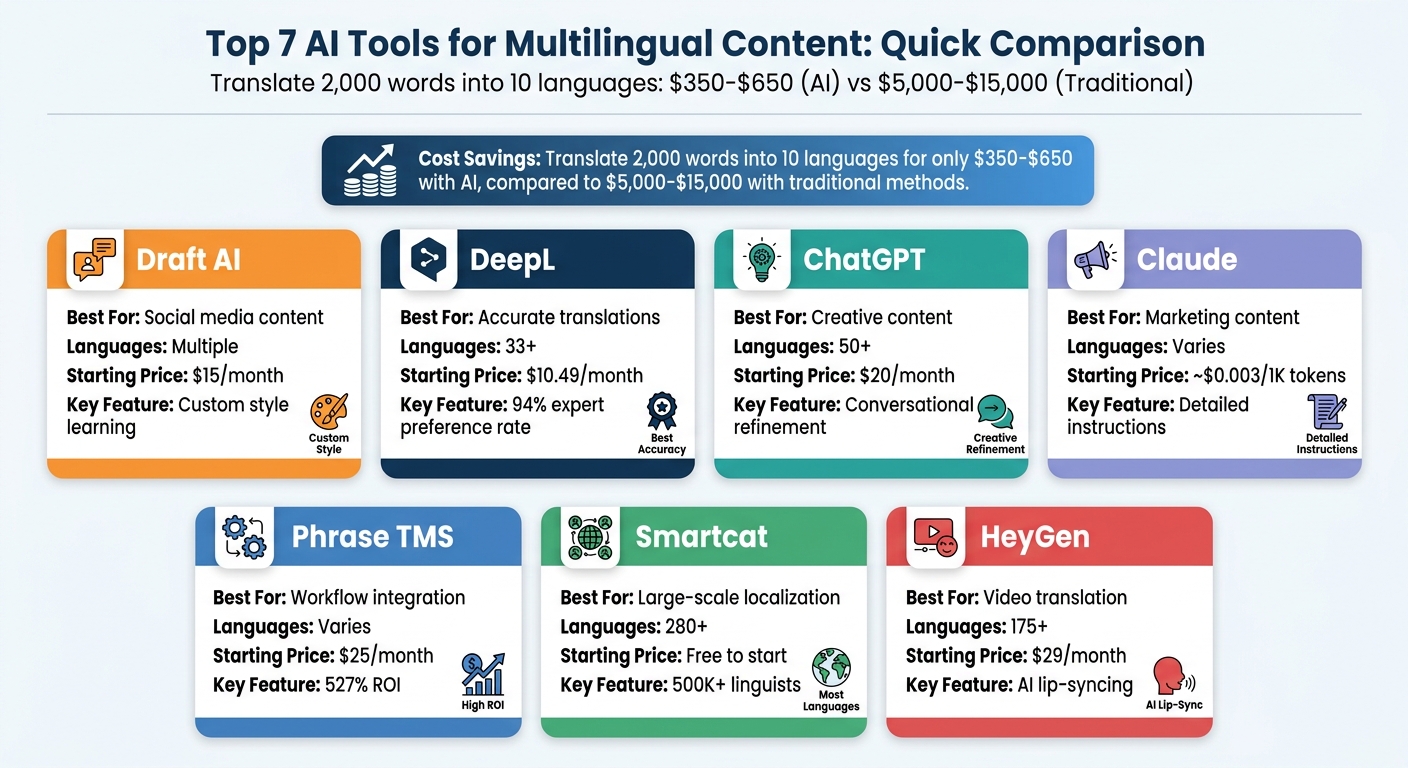
AI Translation Tools Comparison: Features, Languages & Pricing
1. Draft AI
Draft AI focuses on creating social media and short-form content. It can produce posts, carousels, Instagram Reels scripts, and threads in multiple languages. Whether you provide a voice message or raw data, the platform transforms it into polished content in just minutes, making it a reliable tool for producing context-aware, multilingual content.
Multilingual Translation Quality
Draft AI uses advanced AI models to ensure translations maintain both context and meaning. These models focus on preserving sentence relationships and keeping your brand's voice consistent across different languages. Plus, the platform incorporates real-time feedback to improve its translations over time.
Customization Features
Draft AI doesn’t just translate - it customizes. By analyzing your existing posts and Reels, it adapts to your brand’s voice and style. It also takes into account your preferred terminology and regional nuances to create content that feels tailor-made. Interactive prompts allow you to tweak tone and audience focus, ensuring everything from LinkedIn carousels to Instagram captions aligns with your brand’s identity.
Workflow Integration
The platform fits seamlessly into your workflow with its intuitive, swipe-based interface, similar to Tinder. Share your business or blog details, and Draft AI will generate a variety of content ideas, each complete with viral hooks. You can review and save these ideas for future use. This parallel content creation process eliminates the need for traditional, step-by-step translation models, saving time and effort.
Pricing and Accessibility
Draft AI offers two pricing tiers:
- Free Plan ($0): Includes voice-to-content generation, text posts for platforms like Telegram, LinkedIn, and Facebook, and language switching. However, it limits you to 3 topics and a set number of generation credits.
- Draft Pro ($15/month or about $120/year): Unlocks unlimited content generation, custom style analysis, all content formats (like carousels and Reels scripts), and unlimited topic creation. The yearly plan also comes with a 7-day free trial.
sbb-itb-9f5fe42
2. DeepL
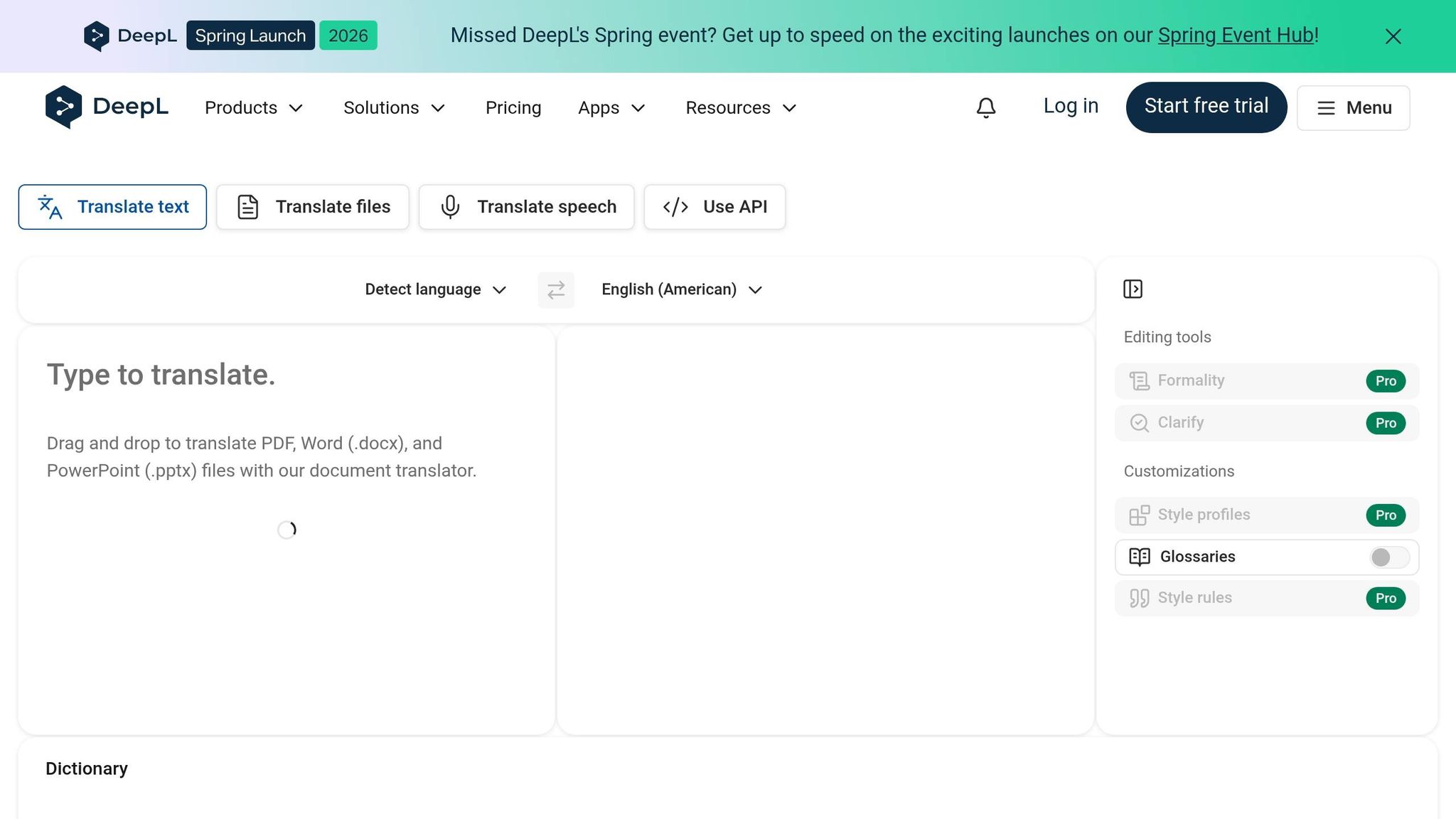
DeepL has taken translation to the next level by focusing on precision and natural language flow. Unlike general-purpose AI tools, it uses in-house Large Language Models specifically designed for translation tasks. This specialized approach ensures translations that maintain meaning and sound natural across 37 official languages, with over 100 more currently in beta testing.
Multilingual Translation Quality
DeepL's performance in translation accuracy has set a high standard. In 2026, blind evaluations revealed that human experts favored DeepL's translations 94% of the time compared to competitors. It achieved a 100% win rate in direct comparisons with Microsoft Translator and Google Translate, and also outperformed GPT 5.2 and Claude Opus 4.6 with win rates of 100% and 81%, respectively.
Additionally, DeepL's output requires significantly fewer edits - three times fewer than ChatGPT-4 and twice fewer than Google Translate. Jakub Kalina, Head of Localization at Alza.cz, praised the platform’s impact when Czech was added:
"When DeepL began supporting Czech, we were quite surprised with the difference in quality. It sounded much more natural".
Customization Features
DeepL offers tools to tailor translations to specific needs. Features like Glossaries allow users to manage technical terms, while Style Rules help set the tone for translations. Translation Memory ensures consistency by reusing previously approved translations. For languages like German, French, and Spanish, the platform provides formality controls, enabling users to switch between formal and informal tones to suit their audience.
The DeepL Agent further enhances the process by reviewing source content for inconsistencies and offering suggestions to maintain brand consistency. Christian Svendsen, CEO of 24Translate, highlighted the benefits:
"Our linguists really enjoy working with DeepL-powered translations because the superior translation quality means a much easier post-editing process".
Workflow Integration
DeepL seamlessly integrates into workflows via its API, working with platforms like Zendesk, GitHub, and WordPress. It also supports industry-standard CAT tools while preserving formatting for documents in Word, PDF, and PowerPoint.
For live collaboration, DeepL Voice offers real-time translated captions for Zoom and Microsoft Teams meetings. Businesses have reported a 90% reduction in time spent on translations and a 345% return on investment over three years, showcasing the platform's efficiency.
Pricing and Accessibility
DeepL offers flexible pricing options to cater to different needs:
- Free: 5,000 characters per month with basic features
- Starter ($10.49/month): 5 million characters per year, including document translation
- Advanced ($34.49/month): Adds team features, glossaries, and CAT tool integration
- Ultimate ($68.99/month): Unlimited usage, DeepL Agent access, and full API capabilities
The platform is accessible through web browsers, desktop and mobile apps, and browser extensions, making it convenient for users across various devices.
3. ChatGPT
ChatGPT takes a conversational approach, making it easy to refine outputs with natural prompts. For example, you can specify a target audience like "luxury beauty" or request adjustments such as a "less stiff" tone. This ability to combine conversational ease with creative and technical precision sets ChatGPT apart.
Multilingual Translation Quality
ChatGPT supports translations in over 50 languages, excelling in creative and marketing content for Asian language pairs like English-to-Japanese and English-to-Chinese. In a 2026 review, it achieved a score of 8.8 out of 10 for translation tasks and can handle documents up to 50 pages long. However, its technical accuracy is less consistent. For example, a linguistic test across Portuguese, Spanish, Italian, and Latvian yielded a score of 2.5 out of 5, highlighting room for improvement in technical translations.
Customization Features
ChatGPT allows users to create Custom GPTs with pre-set instructions and reference materials, making it possible to develop specialized translation engines tailored to your brand voice. This eliminates repetitive prompts and keeps multilingual content aligned with your global messaging. The tool can also produce a variety of outputs, from text to audio tracks. However, without precise prompts, it may sometimes deviate from the intended tone.
Workflow Integration
ChatGPT’s API enables integration with internal systems and third-party tools. For larger localization projects, it works effectively with Translation Management Systems (TMS) like Lokalise, which use Translation Memory and glossaries to maintain consistency. For simpler workflows, you can generate content in English and translate it into multiple languages at once. However, evaluations by native speakers suggest that creating content directly in the target language often results in more natural-sounding outputs, with an average quality score of 7.9 out of 10.
Pricing and Accessibility
ChatGPT offers several pricing tiers to suit different needs:
- Free tier: Ideal for casual users.
- ChatGPT Plus: $20/month.
- ChatGPT Business: Starts at $25/user/month (or $20/user/month if billed annually, with a two-seat minimum).
- ChatGPT Pro: Available at $100 and $200/month for high-volume users.
- API pricing: Approximately $0.06 per 1,000 input tokens and $0.12 per 1,000 output tokens (1,000 tokens equate to about 750 words).
These options make ChatGPT accessible for both individual users and businesses with more complex requirements.
4. Claude
Claude offers a prompt-driven approach that thrives on detailed user instructions, making it ideal for multilingual content creation. With its "translation specs", you can establish fixed guidelines that dictate how the AI handles brand rules, formatting, and character limits across different content batches. This feature is particularly handy for teams looking to achieve consistency without having to fine-tune every single request.
Multilingual Translation Quality
In multilingual testing across languages like Portuguese, Spanish, Italian, and Latvian, Claude Sonnet 4.5 earned a score of 3.5 out of 5, surpassing ChatGPT's score of 2.5. It stands out for its ability to deliver creative rewrites and adapt tones, making it an excellent choice for marketing content that requires a more natural and engaging style rather than a straightforward translation. Standard translations are typically completed in about 1 minute. However, since Claude doesn’t offer native glossary or translation memory features, teams may need to rely on MTPE (Machine Translation Post-Editing) for managing terminology.
Customization Features
Claude's role-based prompting allows users to instruct the AI to act as a native marketing copywriter for specific regions, ensuring the content aligns with the target audience. You can tailor outputs by setting parameters like sentence length, reading levels (e.g., B1 or C1), and even choosing between active or passive voice. For added precision, specify the target locale (e.g., "Spanish for Mexico") to enhance regional accuracy. While it lacks built-in translation memory, Claude can integrate with tools like Lokalise to apply such resources during content creation.
Workflow Integration
Claude’s customization capabilities extend to seamless integration with existing systems. Through API connections and third-party platforms, it can link to CMS tools, marketing platforms, and cloud storage. Plug-and-play connectors simplify the process, while no-code interfaces allow teams to build workflows tailored to specific content types without requiring advanced technical skills. By reusing the same translation spec prompts across different content batches, teams can maintain consistent quality in their multilingual outputs.
Pricing and Accessibility
Claude Sonnet 4.5 employs a token-based pricing model, making it adaptable for various needs. The cost is approximately $0.003 per 1,000 input tokens and $0.015 per 1,000 output tokens, with 1,000 tokens equating to roughly 750 words.
5. Phrase TMS
Phrase TMS brings together multilingual content management for documents and digital assets, offering a centralized solution for streamlined translation and localization.
Building on its strong translation and customization features, Phrase TMS enhances these capabilities with seamless workflow integrations.
Multilingual Translation Quality
Phrase TMS incorporates MT Autoselect, an AI-driven feature that automatically selects the most suitable translation engine from over 30 providers - such as DeepL, Google, and Amazon - based on the language pair and content type. It also includes Quality Prediction Scoring (QPS), which flags segments with low confidence for review. This feature reduces post-editing efforts by an impressive 45%. Václav Baláček, Director at Czech Translations, highlighted the platform's impact:
"With Phrase NextMT, our customer's translation memories no longer compete with machine translation, but actively improve its quality".
Phrase TMS has earned a 9.1/10 user rating on G2 and was recognized as the top translation management system by the Nimdzi Compass Guide.
Customization Features
The platform offers tools to tailor translation models to a brand's specific needs using Phrase Custom AI, which trains models on brand terminology and historical data. It also supports the creation of Term Bases (glossaries) that integrate directly into translation engines. The Phrase Auto Adapt feature employs generative AI to refine content for linguistic and cultural nuances without needing manual adjustments, while Phrase Next GenMT uses Translation Memory to ensure contextually accurate, on-brand translations. According to a Forrester Consulting study, these features delivered a 527% ROI, saving customers nearly $2.8 million in localization costs. These tools simplify the localization process and help maintain high-quality multilingual content.
Workflow Integration
Phrase TMS supports over 50 file formats and integrates seamlessly with platforms like Contentful, WordPress, GitHub, and Figma. Its Phrase Orchestrator offers a no-code, drag-and-drop interface, allowing users to automate workflows without requiring engineering expertise. Yoko Drain, Sr. Director of Product Globalization at Zendesk, noted:
"Phrase gives Zendesk the ability to automate many processes, allowing us to use AI solutions effectively. With the right automation in place, we can scale our operations further and continue to improve quality".
The platform ensures 99.9% uptime with zero-downtime deployments and adheres to ISO 27001 and GDPR standards.
Pricing and Accessibility
Phrase TMS helps companies cut translation costs by up to 55% and speeds up resolution times by 50%. For broader accessibility, Phrase Portal provides a secure interface that allows employees to access approved machine translation, reducing the risks associated with free online tools.
6. Smartcat
Smartcat blends AI-driven translation with a network of over 500,000 professional linguists to deliver fast, reliable translations in more than 280 languages.
Multilingual Translation Quality
Smartcat employs specialized AI agents tailored for various content types - like documents, websites, software, and media - streamlining the entire localization process. Its system starts with an 85% accuracy rate, improving to over 95% with human edits. Christopher Goodsell, Manager for Instructional Systems Design at AMPP, shared his experience:
"It took around 10 minutes for us to have an Articulate course translated into many languages. Before Smartcat it could sometimes take a year."
The platform boasts a 4.6/5 rating on G2 and is trusted by 20% of Fortune 500 companies.
Customization Features
Smartcat's Agent Builder allows you to create custom AI agents that align with your brand guidelines, glossaries, and compliance rules - all without needing to code. You can upload existing style guides and translation memories, and the system will apply them across its supported languages. Stanley Black & Decker used this feature to cut global content costs by 70%, all while ensuring consistent quality across 40+ countries. Additionally, the platform supports over 50 file formats and even offers AI-generated voice-overs for video and audio projects.
Workflow Integration
Once customized, Smartcat integrates smoothly with your existing tools. With 30+ direct integrations - including WordPress, Figma, Contentful, and Salesforce - it enables automatic two-way content flow, eliminating the need for manual file handling. Smith+Nephew used these workflows to boost their global content turnaround time by 400%. Julia Emge, Head of Translations at Expondo, highlighted the results:
"Our productivity increased by 50% while our outsourcing expenses dropped by half."
Pricing and Accessibility
Smartcat offers a free starting plan with a 15-day trial and an unlimited seat model, letting you invite as many team members as needed without extra fees. Its linguist Marketplace costs 4–5 times less than traditional translation agencies. With scores of 9.6/10 for ease of setup and 9.3/10 for ease of use, Smartcat ensures teams can quickly adapt and implement its tools. This combination of affordability and functionality makes it a strong choice for supporting global content strategies.
7. HeyGen
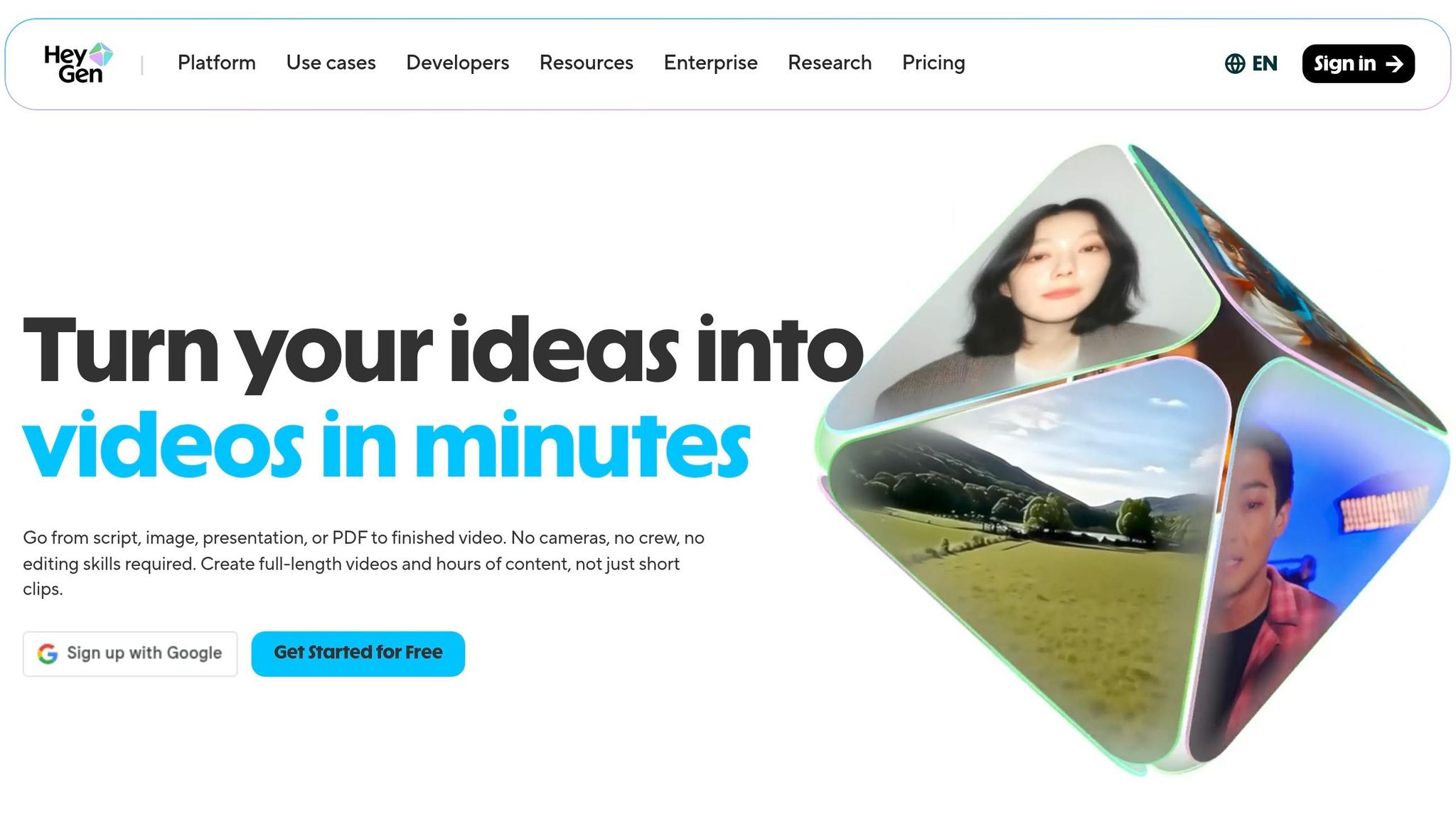
HeyGen brings something exciting to the table with its focus on video content translation. Using advanced lip-syncing and voice cloning technology, it adjusts the speaker's mouth movements to align with translated audio, giving the impression that the video was originally created in the target language. With support for over 175 languages and dialects on its paid plans - and a free trial covering 30+ languages - it’s a robust solution for multilingual video production.
Multilingual Translation Quality
One of HeyGen's standout features is its AI-driven lip-syncing, which effectively addresses the awkward mismatches commonly seen in dubbed videos. The platform boasts translation accuracy rates of 95–98% and lip-sync precision exceeding 95% for front-facing speakers. Its voice cloning technology is equally impressive, requiring just 30 seconds of source audio to replicate the speaker's tone, pitch, and emotional depth. To maintain ethical standards, HeyGen mandates a verbal release from the original speaker before cloning their voice. The system is particularly effective with languages such as Japanese, Korean, Chinese, Vietnamese, Arabic, and Hebrew.
Customization Features
HeyGen offers a range of customization tools to enhance the translation process. The Dynamic Duration feature automatically adjusts video timing to accommodate the length of translated scripts, which is especially useful for languages like German or French that often require more text. Users can translate both spoken dialogue and on-screen text simultaneously, ensuring complete localization. The platform also supports Brand Voice profiles, allowing users to specify terms, brand names, or technical jargon that should remain untranslated or be treated in a specific way. For added flexibility, the Script Proofread option lets users manually refine AI-generated translations, which can cut translation costs by 80% and speed up video production by 10×. Localization through HeyGen reportedly saves around $1,100 per minute compared to traditional methods.
Workflow Integration
HeyGen integrates effortlessly with tools like Canva, Zapier, and a robust API for batch processing, making it ideal for large-scale projects like online courses and product demos. It also connects with Google Drive and YouTube to streamline content distribution. With compliance standards including SOC 2 Type II, GDPR, and CCPA, the platform is well-suited for enterprises handling sensitive data.
Pricing and Accessibility
HeyGen offers a free plan that includes 3 videos per month, each up to 1 minute long, with trial access to lip-synced translations in over 30 languages. The Creator plan costs $29/month (or $24/month with annual billing) and includes 200 credits for up to 40 minutes of video translation. The Pro plan is priced at $99/month (or $79/month billed annually), offering 2,000 credits and up to 400 minutes of translations. For larger teams, the Business plan starts at $149/month for the first seat, with an additional $20 per seat.
With a 4.8/5 rating from over 1,000 reviews and recognition as G2’s fastest-growing product, HeyGen has earned high praise. However, lip-sync quality may drop when speakers are in profile or partially obscured, and costs can rise quickly for long-form content like webinars.
Feature Comparison Table
Here's a breakdown of how seven tools measure up in terms of features, language support, and pricing, helping you align your choice with your needs and budget.
| Tool | Key Features | Supported Languages | Starting Price |
|---|---|---|---|
| Draft AI | Voice-to-content generation, multilingual translation, custom style learning, carousel & script creation, unlimited topics (Pro) | Multiple languages (free translation for all users) | Free; Pro at $15/month |
| DeepL | Glossary support, document translation (PDF/Word), API access, high accuracy for European languages | 33 languages | $9/month |
| ChatGPT | Original content generation, custom instructions, natural tone, handles right-to-left languages like Arabic | 50+ languages | $20/month |
| Claude | Fast drafts and rewrites, large context window for long documents, token-based pricing | Varies | ~$0.003 per 1K input tokens |
| Phrase TMS | Translation memory, human-in-the-loop workflow, AI translation with review processes | Varies | $25/month |
| Smartcat | Generative AI translation, video & e-learning support, Linguist Marketplace, unlimited seats | 280+ languages | Free to start |
| HeyGen | AI lip-syncing, voice cloning, video translation, brand voice profiles, dynamic duration adjustment | Varies | Contact for details |
The table provides a snapshot, but let's dive deeper into how these tools cater to different project scales and budgets.
DeepL Pro and ChatGPT Plus are consistently rated highly for translation quality. For example, Google Translate scores just 6.8 out of 10, which falls short for professional marketing content. On the other hand, Smartcat achieves over 85% accuracy by leveraging human feedback, making it a strong option for teams seeking a balance between AI speed and human precision.
If your team works with 2–4 languages, simpler tools may offer the best balance of cost and efficiency. However, for managing 5+ languages, tools like Phrase TMS, Smartcat, or Lokalise (starting at $120/month) provide the workflow integration and consistency needed for larger-scale projects.
For cost perspective, translating a 2,000-word article into 10 languages with AI typically ranges from $350 to $650, compared to $5,000–$15,000 with traditional agencies.
HeyGen stands out for video localization, offering advanced AI lip-syncing that can save approximately $1,100 per minute compared to traditional methods.
Lastly, Draft AI is ideal for creating multilingual social media content, with its Pro plan offering unlimited content generation for just $15/month.
Each tool brings unique strengths to multilingual content workflows, making it easier to find the right fit for your specific needs.
Conclusion
When it comes to choosing the best tool for your needs, it all boils down to your workflow and priorities. Draft AI is perfect for speeding up content creation for social media, offering unlimited multilingual posts for just $15/month without sacrificing quality. DeepL stands out for its precision in European languages, while ChatGPT shines when crafting creative marketing copy or handling right-to-left languages like Arabic. For teams juggling five or more languages, Phrase TMS and Smartcat streamline workflows and ensure consistent brand messaging.
The cost of AI translation has dropped significantly - translating a 2,000-word article into 10 languages now ranges from $350 to $650, compared to the hefty $5,000–$15,000 charged by traditional agencies. This affordability opens the door for businesses of all sizes to expand their global reach.
Here’s a quick breakdown: rely on DeepL for highly accurate European translations, turn to ChatGPT for tone-sensitive content, and use HeyGen for sharp video localization. For maintaining brand consistency, Smartcat and Phrase TMS are invaluable, automatically applying glossaries and translation memories.
With 75% of internet users favoring content in their native language, the right multilingual tools can help you build genuine connections with global audiences. Whether you’re an independent creator or part of a large enterprise, these seven tools empower you to engage effectively and affordably across languages and cultures.
FAQs
Which tool should I pick for my content type (social, docs, or video)?
The best AI tool for your needs depends on the type of content you're creating. If you're focused on social media, Draft AI shines with its ability to generate viral content ideas, customize visuals, and even translate into multiple languages. For documents, tools like Smartcat AI Generator stand out, offering support for over 280 languages to create localized content. While no specific tool for video content is highlighted, Draft AI can still handle tasks like scriptwriting and caption creation, making it a flexible option for various formats.
How do I keep brand voice consistent across every language?
To keep your brand voice consistent across multiple languages, consider leveraging AI tools that can learn and mimic your tone, preferred terminology, and overall style. These tools improve over time with human feedback and edits, helping maintain uniformity in translations. Using platforms that incorporate style guides and glossaries can also boost accuracy. Make it a habit to update these resources regularly to ensure your content reflects your brand identity in every language.
When should I use human review instead of AI-only translation?
When accuracy, cultural nuance, and context are essential, relying on human review is key. AI might miss subtle elements like idiomatic expressions or shifts in language trends, which can affect the quality of a translation. Human expertise ensures the translation reflects the intended tone and respects cultural sensitivities.