5 Tips For Customizing AI Brand Voice
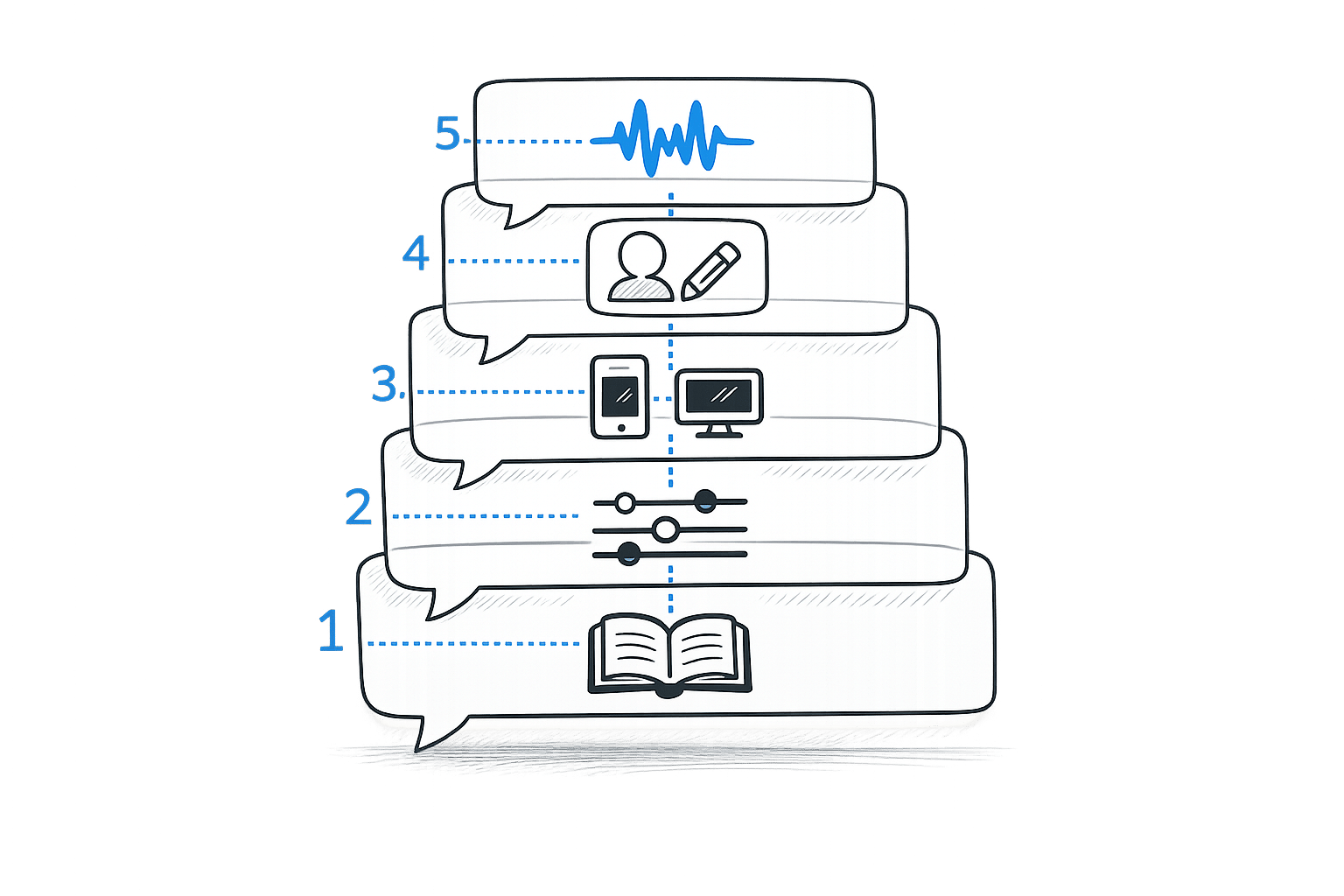
Your brand voice is what makes your content memorable and trustworthy. But AI tools often produce bland, generic content unless you teach them to reflect your unique style. Here's how to make AI work for your brand:
- Use your best content as examples: Upload high-performing blog posts, emails, or social media captions to show the AI your voice.
- Define your voice traits clearly: Break down your personality, tone, rhythm, and vocabulary into actionable rules.
- Leverage AI tools like Draft AI: Create a lasting voice profile that ensures consistency across all platforms.
- Test and refine: Regularly audit content on different platforms to maintain a cohesive voice.
- Adapt as your brand evolves: Use tools to update your voice profile and ensure consistency across languages and channels.
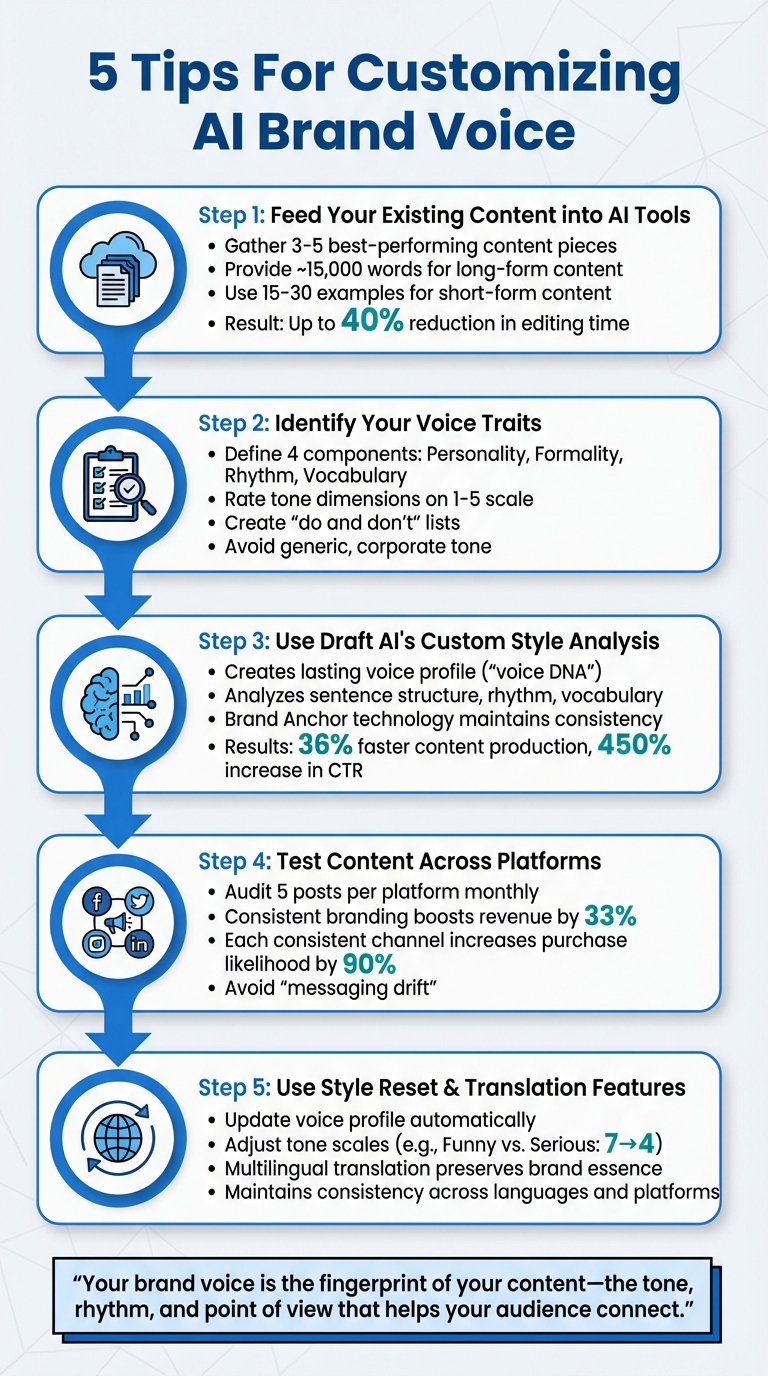
5-Step Process for Customizing AI Brand Voice
1-Minute ChatGPT Hack To Write In Your Brand Voice & Style
This hack works best when paired with the best content creation tools to scale your output.
sbb-itb-9f5fe42
1. Feed Your Existing Content into AI Tools
To teach AI your brand's voice, it's better to show it examples of your work rather than just describing it. Your existing content already captures the rhythm, vocabulary, and personality that make your brand stand out from generic, corporate tones.
Start by gathering 3–5 of your best-performing content pieces - these could be blog posts, emails with high open rates, or social media captions that drove engagement. Avoid using content created under tight deadlines or heavily edited by committees, as those might not reflect your true voice. For long-form content, aim to provide around 15,000 words in total. For short-form materials like social posts or ads, 15–30 solid examples should suffice.
Depending on the tool you're using, there are different ways to upload your content. For instance, ChatGPT Plus's Custom GPTs let you upload up to 20 files in formats like PDF, DOCX, or TXT. Another option is to provide your blog's homepage URL, and the tool can retrieve content automatically. If you're working with more technical tools, organizing your content into structured formats like JSON or CSV - tagged by tone (e.g., "playful" or "technical") or channel (e.g., email vs. tweet) - can help the AI better understand the nuances of your voice. These steps can lead to noticeable efficiency improvements right away.
Teams that use AI tools with tone-specific training have reported up to a 40% reduction in editing time and a boost in engagement within hours. One expert noted that these tools can adapt to your unique writing style quickly. As Ashwini Pai, Senior Copywriter at Typeface, explains:
A dedicated AI brand voice tool trains directly on your actual content. Instead of describing your voice, you show it examples... and it learns the specific patterns that make your writing yours.
Take the time to document your vocabulary rules. Include words and phrases you always want to use, as well as those you want to avoid. Providing "anti-examples" of what your brand should not sound like helps set clear boundaries, ensuring the AI doesn't default to a generic corporate tone when generating longer pieces. Laying down these rules now will make future fine-tuning much smoother.
2. Identify Your Voice Traits and Avoid Mistakes
Before automating content creation in your brand's voice, you need to pinpoint exactly what that voice sounds like. Skip vague descriptors like "friendly" or "professional" and focus on the nuts and bolts of your voice. Think of voice as your brand's personality that stays consistent, while tone adjusts that personality to fit different situations.
Start by breaking your voice into four key components: personality (are you an expert, a playful guide, or a disruptor?), formality level (do you write "Hey there!" or "It is my pleasure to..."), rhythm (short and snappy versus long and flowing), and vocabulary (specific words you use and the jargon you avoid). To make this actionable, rate tone dimensions - like funny to serious, formal to casual, or enthusiastic to matter-of-fact - on a 1–5 scale. These clear metrics will help you set precise guidelines for your AI tools.
Avoid relying on AI to define your voice with generic terms. As Mash Bonigala, Creative Director at Spellbrand, explains:
Generic is the enemy of brand. Your brand voice needs to be distinctive enough that it could not be confused with a competitor's, and default AI output is the opposite of distinctive.
Watch out for "instruction drift", where AI veers off from your voice guidelines in longer pieces. Also, steer clear of jargon overload and the "authenticity gap", where the quirks that make your voice relatable get smoothed out.
To keep things consistent, create "do and don't" lists with specific examples. For instance, instead of saying "be conversational", clarify what that means: choose "straightforward" over "holistic." Document phrases to avoid, like "best-in-class" or "game-changing", which can feel bland or overused. Review your top-performing pieces - 5 to 10 of them - to spot patterns in how you structure sentences and choose words.
Define your voice manually before involving AI. Use human insight to establish your brand's personality and tone, then provide the AI with clear examples and rules to follow. This groundwork ensures your brand doesn’t get lost in a generic, overly cheerful AI voice that lacks personality and memorability.
3. Use Draft AI's Custom Style Analysis
Once you've outlined your voice traits, Draft AI's custom style analysis takes things a step further. This feature doesn’t just follow basic instructions - it creates a lasting voice profile, almost like your brand's "voice DNA", to ensure every piece of content stays consistent. It builds on the groundwork you’ve already laid, reinforcing a unified tone across all your materials.
Here’s how it works: Draft AI starts by analyzing your existing content from multiple sources. You can upload blog URLs, social media posts (like those from X, formerly Twitter), or even documents. The AI digs into the details - sentence structure, rhythm, vocabulary, and even quirky phrasing habits. It also picks up on deeper elements, like how you use rhetorical devices or transitions, to capture the essence of your style.
What sets Draft AI apart is its Brand Anchor technology, which keeps your voice consistent throughout content creation. Unlike other tools that may lose track of style guidelines in longer pieces, Brand Anchor ensures your tone stays on point. It even learns from your edits - so if you prefer "use" over "utilize", it remembers that. A 2025 study found that personalized AI-generated marketing content was rated much higher in creativity and quality compared to generic outputs. This constant alignment means every post reflects your brand's identity.
To get the best results, upload your top-performing content - think high-engagement blog posts or successful email campaigns. You can also provide "anti-examples" to show what doesn’t fit your brand’s voice, helping the AI refine its understanding even further.
The results speak for themselves: companies using AI-driven brand voice tools have reported up to 36% faster content production and a 450% increase in click-through rates. Plus, about 92% of knowledge workers prefer tools that adapt to specific brand guidelines. With Draft AI’s custom style analysis, you get a voice profile that evolves alongside your brand, ensuring every piece of content feels authentic and aligned.
4. Test Content Across Platforms and Refine
Creating AI-generated content is just the starting point - testing how it performs across different platforms is where the real work begins. A polished LinkedIn post might come across as too formal on TikTok, while the casual tone that works on Twitter could feel out of place in an email newsletter. Each platform has its own style and audience expectations, and when something doesn’t align, it’s noticeable. And not just noticeable - it can affect your revenue.
Studies show that maintaining consistent branding across platforms can boost revenue by up to 33%. Plus, every additional consistent channel increases the likelihood of purchase by 90%. But here’s the catch: even with consistent branding, 60% of companies report revenue growth of only 10–20%. Why? The problem often lies in subtle tone shifts - what’s known as "messaging drift." Over time, these small inconsistencies can chip away at your brand identity, leaving your audience with a sense that something feels "off", even if they can’t pinpoint why.
"Messaging drift - subtle tone shifts across channels - creates brand fragmentation that accumulates slowly until your audience instinctively feels something is off without being able to articulate why." - AtomWriter
To avoid this, regularly audit your content. A simple way to do this is by pulling five posts from each platform every month and reading them aloud. If the tone feels like it’s coming from different personalities rather than a single, cohesive voice, it’s a sign that your core brand elements - such as vocabulary and tone - might be slipping. Pay attention to the edits you make to AI-generated drafts. For example, if you consistently swap out "utilize" for "use" or cut filler phrases like "in today’s fast-paced world", these changes should become part of your AI style guide.
Tools like Draft AI can make this process easier. The platform learns from your edits, adapting over time to reflect your preferences. As you refine drafts, it remembers your choices and applies them to future content. This creates a feedback loop where your brand voice evolves dynamically, ensuring every piece of content stays consistent while adapting to the unique demands of different platforms.
5. Use Draft AI's Style Reset and Translation Features
Your brand evolves as your business grows and your audience changes. Maybe you started with a casual, playful tone but now need a more authoritative voice to connect with a new market. Or perhaps you're expanding internationally, where maintaining a consistent tone across languages becomes crucial. Draft AI's style reset and multilingual translation features help you adapt without having to start over.
The style reset feature works like an upgraded voice profile for your brand. Once you update your voice profile, it automatically applies those changes to all future content. This makes rebranding or shifting strategies much smoother. You can fine-tune specific traits, like adjusting a "Funny vs. Serious" scale from 7 to 4, ensuring your updated tone stays consistent over time. This tool not only aligns your voice across revisions but also strengthens its consistency on a global level.
Paired with the style reset, Draft AI's multilingual translation ensures your brand's refined voice carries seamlessly across languages. It goes beyond word-for-word translation by distinguishing between fixed elements - like your core personality and communication style - and flexible ones, such as idioms or sentence structure. This approach adapts your content to local nuances while preserving your brand's essence. Together, these features ensure your updated voice works across languages and platforms, creating a unified identity whether your audience finds you on LinkedIn, Instagram, or elsewhere.
Conclusion
Your brand voice is like a signature - it sets you apart and helps build trust with your audience. These five tips work together to keep that voice consistent and genuine. Start by feeding AI with your existing content to embed your brand's DNA. Then, define clear voice traits to set boundaries, use Draft AI's style analysis to uncover patterns you might miss, test and refine your voice across platforms to catch inconsistencies early, and adjust as your business evolves. Together, these steps turn abstract ideas into actionable guidelines that AI can follow effectively.
This structured process helps avoid "instruction drift", where AI might stray from your guidelines and revert to generic, corporate-sounding content. Plus, it ensures your brand voice delivers measurable results.
As Katina Hristova, Strategy Lead, explains:
Your brand voice is not just a preference. It is the fingerprint of your content - the tone, rhythm, and point of view that helps your audience connect with what you say.
Remember, this isn’t a one-time task. Your brand voice should evolve alongside your business. Regularly review AI-generated drafts and update your style guide monthly. Transform vague adjectives like "friendly" into actionable rules, such as "use contractions in 90% of sentences" or "keep sentence length between 14–18 words". Build your voice on unchanging pillars while adapting tone for platforms like LinkedIn, Instagram, or TikTok.
Take the first step today - upload three of your best-performing posts into Draft AI and see what patterns emerge. With Draft AI's tools, you can ensure your content reflects your brand's unique voice across all platforms and languages. Keep refining as your business grows to maintain a consistent, standout voice.
FAQs
How do I choose the best content samples to train my brand voice?
To shape your brand voice effectively, start by gathering high-quality examples that truly represent your brand's tone, style, and personality. Look for content that highlights your distinctive vocabulary, phrasing, sentence structure, and emotional nuances.
Compile these standout pieces into a reference folder, pulling from your best-performing content across various platforms. This collection will serve as a roadmap for training AI to understand and replicate your voice. Regular testing and fine-tuning with these samples will help ensure the AI produces content that matches your brand's identity.
What causes AI “instruction drift,” and how do I stop it?
AI "instruction drift" occurs when responses begin to deviate from the intended brand voice or style over time. This can happen because of repeated interactions, varied user inputs, or updates to the model that introduce inconsistencies. To combat this, it's essential to establish clear voice guidelines, train the AI with consistent examples, and regularly review its outputs for alignment. Tools like shared templates, stable prompts, and enforceable tone rules are effective for keeping responses aligned with your brand's voice and ensuring consistency.
How can I keep my brand voice consistent across platforms and languages?
To keep your brand voice consistent, start by developing a clear style guide. This should define your tone, rhythm, and personality traits so that anyone creating content understands exactly how your brand should sound. When using AI tools, train them with 3–5 strong examples that reflect your brand's voice. Features like Custom Instructions can further refine the tone and vocabulary to match your needs.
Make sure to set up regular feedback loops and conduct quality checks. These steps help catch any deviations early, ensuring your voice remains genuine and consistent across all platforms and languages.