AI Trends Shaping Social Media Content 2026
AI is now part of the day-to-day social media workflow. In 2026, most teams use it to cut production time, tailor posts for different audiences, and turn one idea into many formats and languages.
Here’s the short version:
- 94% of marketers plan to use AI in content creation in 2026
- 88% already use AI tools daily
- AI helps teams go from one source file to posts, carousels, threads, and short video scripts
- Teams use it most for automation, personalization, and multilingual output
- Human review still matters for facts, tone, and brand fit
If I had to sum up the whole article in one line, it would be this: AI should handle the production work, while people make the final call.
What matters most in 2026:
- Automate the repeatable work
- Shape content for each audience
- Reuse one idea across formats and languages
- Keep a clear brand voice guide
- Review every draft before publishing
A few numbers stand out. Some brands report a 67% drop in production time, and AI-shaped content can drive up to 6x higher engagement when the message fits the audience. But there’s a problem too: 52% of consumers say AI content feels generic. So volume alone is not enough.
| Focus area | What AI does | What people should do |
|---|---|---|
| Automation | Drafts, rewrites, format changes, scheduling help | Review output and guide direction |
| Personalization | Tailors posts by audience and channel | Set voice, message, and approval rules |
| Multilingual content | Translates and reshapes content for new segments | Check meaning, tone, and local fit |
So if you want the simplest takeaway, it’s this: start with one repeatable workflow, add audience shaping next, then expand into more formats and languages. That’s the model many teams are using now.
6 Social Media Trends That Will Define 2026
sbb-itb-9f5fe42
AI automation is turning social media into an end-to-end workflow
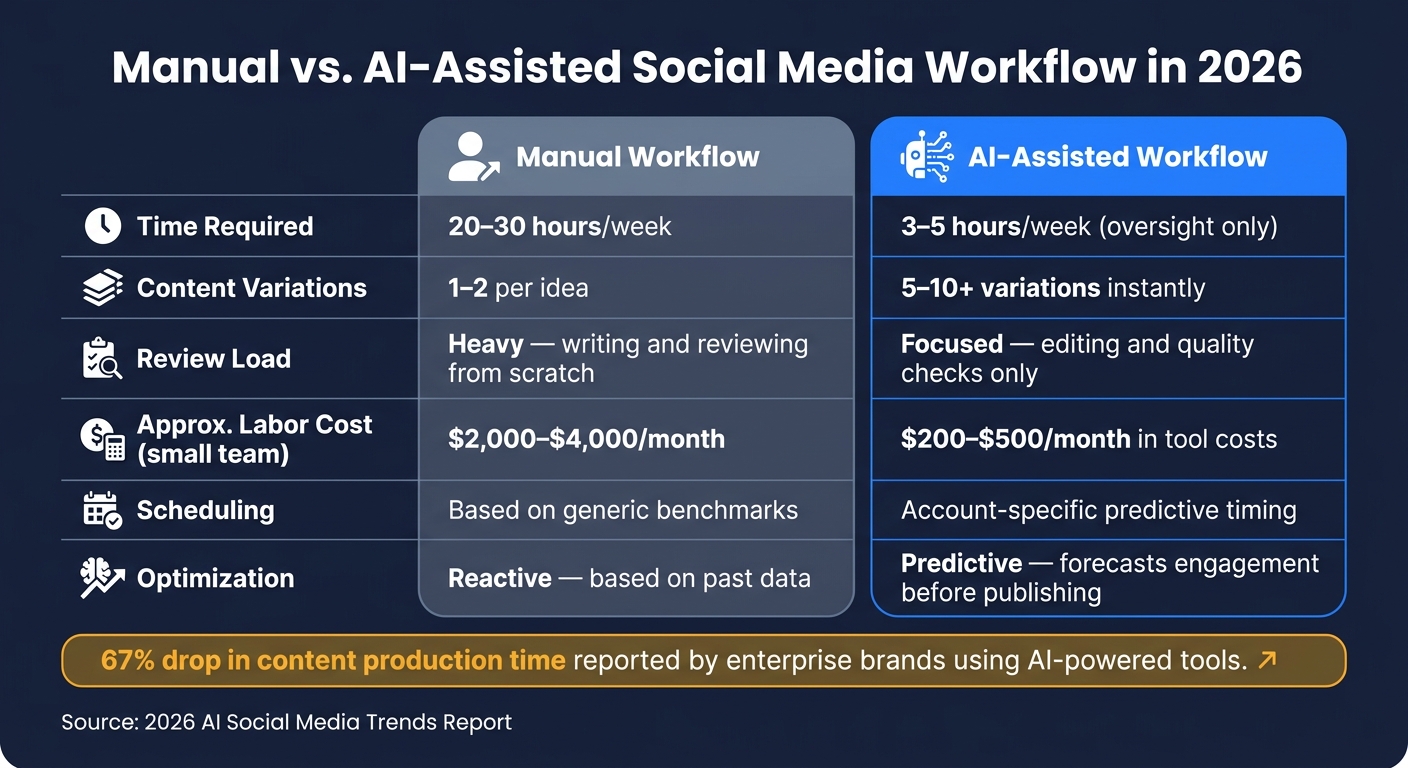
Manual vs. AI-Assisted Social Media Workflow: Time, Cost & Output in 2026
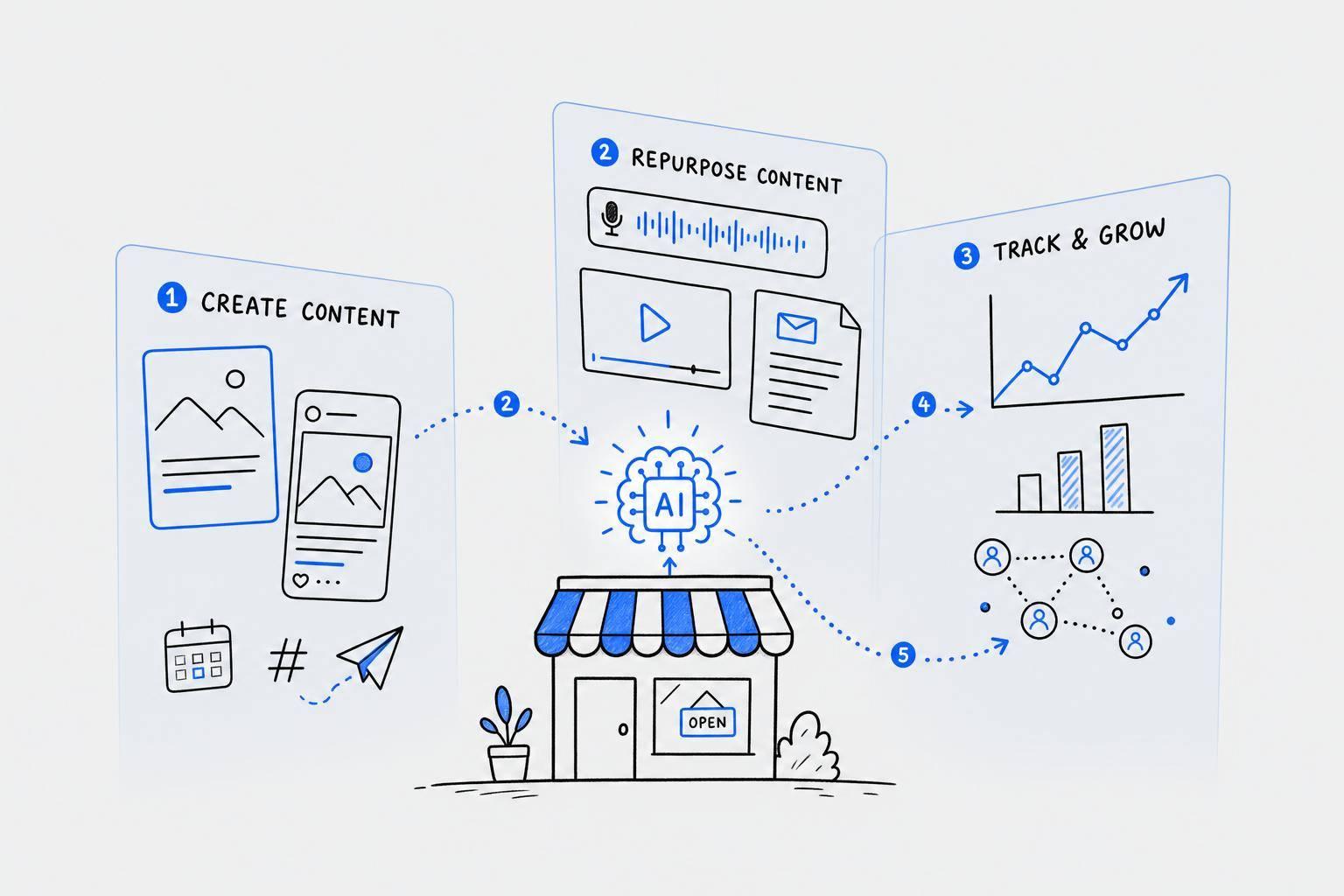
In 2026, AI is changing social media from a manual checklist into an end-to-end workflow. 87% of marketers use generative AI in at least one recurring workflow, up 36 points from 2024. This isn’t about one tool handling one job. It’s about AI taking care of drafting, formatting, and resizing, while people stay focused on strategy, brand voice, and accuracy.
That change matters because it cuts out the slowest part of the job: turning rough ideas into posts that are ready for each platform, allowing teams to create social media posts in minutes.
From idea to published post with fewer manual steps
The biggest time drain in social media has always been the stretch between a rough idea and a post you can actually publish. AI shrinks that gap fast.
Give it a blog post, a voice note, or a transcript, and it can turn that source into hooks, captions, carousel outlines, and short-form video scripts in minutes. It can also produce 5 to 10 versions of the same idea so teams can test different angles without going back to square one.
One source can now do a lot more work. A founder’s webinar or a product update can become:
- a LinkedIn carousel
- an Instagram caption
- a short-form video script
- a thread
And each piece can be formatted for the platform it’s meant for. Enterprise brands using AI-powered content tools report a 67% drop in content production time. That’s not a small gain. It changes how teams work day to day.
How AI supports testing, timing, and content decisions
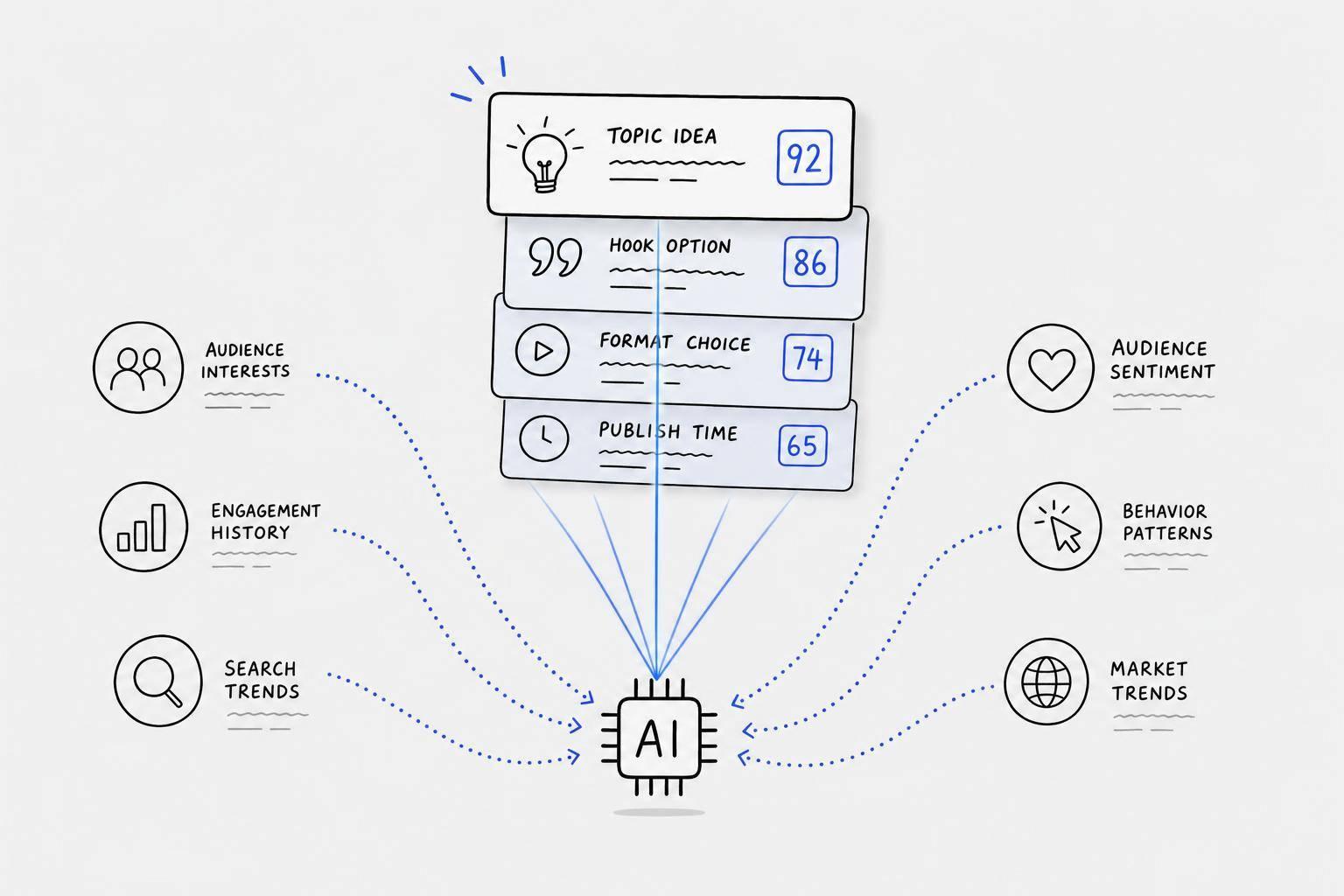
AI also helps teams make better posting decisions. It can help decide what to post, when to post it, and what content is worth putting more money behind.
Instead of relying on generic advice about the “best time to post,” AI uses account-specific timing based on past engagement patterns. It looks closely at the first 30 to 60 minutes after publishing and adjusts around actual follower behavior, not broad benchmarks.
On the paid side, AI spots high-performing assets early and shifts spend toward them as results come in.
Manual workflow vs. AI-assisted workflow: a side-by-side comparison
The gap is easiest to see when you line the two workflows up next to each other.
| Feature | Manual Workflow | AI-Assisted Workflow |
|---|---|---|
| Time required | 20–30 hours/week | 3–5 hours/week (oversight only) |
| Content variations | Usually 1–2 per idea | 5–10+ variations instantly |
| Review load | Heavy - writing and reviewing from scratch | Focused - editing and quality checks only |
| Approx. labor cost (small team) | $2,000–$4,000/month | $200–$500/month in tool costs |
| Scheduling | Based on generic benchmarks | Account-specific predictive timing |
| Optimization | Reactive - based on past data | Predictive - forecasts engagement before publishing |
The strongest setup pairs AI speed with human review for strategy, brand voice, and accuracy. Once production stops being the bottleneck, the next edge comes from relevance: shaping content for each audience.
Personalization is becoming the standard for social content performance
Once AI speeds up content creation, the next issue is simple: does the content feel relevant? On social, speed alone doesn’t win anymore. Relevance does. The post has to speak to the person who sees it. AI-assisted content can drive engagement rates up to 6x higher than manual methods, but that only happens when the content is tailored, not copied from one bland template.
Creating audience-specific posts at scale
One source asset - a webinar transcript, blog post, or founder memo - can turn into many posts for many audiences without forcing the team to start over each time. AI can take one core idea and reshape it for new customers, loyal followers, or local audience segments. It can spot those groups using behavior patterns and engagement history.
It can also adjust tone, format, and CTA for each channel at scale. That sounds great on paper, but there’s a catch: speed matters only if the brand still sounds like itself.
Keeping brand voice without sounding generic
Scale creates a clear risk: sameness. 52% of consumers already feel AI-generated content feels generic. That’s the problem in plain English. If your brand publishes more posts that sound like everybody else, you’re not building a plan. You’re adding noise.
The fix is simple, but it takes discipline. Strong teams create a brand voice document before they scale production. That doc spells out tone, vocabulary, sentence patterns, and what to avoid. Then AI follows that voice instead of making one up.
From there, every draft needs two checks:
- a fact check to confirm accuracy
- a tone check to make sure it fits the platform and sounds like the brand, not a bland press release
One small move helps a lot: add one real brand detail to every draft.
Personalized content vs. generic content: a side-by-side comparison
| Feature | Personalized AI-Assisted Content | Generic One-Size-Fits-All Content |
|---|---|---|
| Engagement Potential | Up to 6x higher engagement rates | Declining; audiences recognize templated output |
| Production Complexity | High initial setup (brand voice training), fast execution | Low setup, but more editing time |
| Data Needs | Requires audience behavior data and brand voice guides | Minimal; relies on basic prompts |
| Perceived Authenticity | High when human-edited and voice-aligned | Low; 52% of consumers find it inauthentic |
The next step is using that same message across languages and formats without losing what it means.
Multilingual and format-adaptive content is expanding reach in 2026
Once your brand voice is in place, AI can carry that same voice across languages and content types.
Better translation and localization for U.S. audience segments
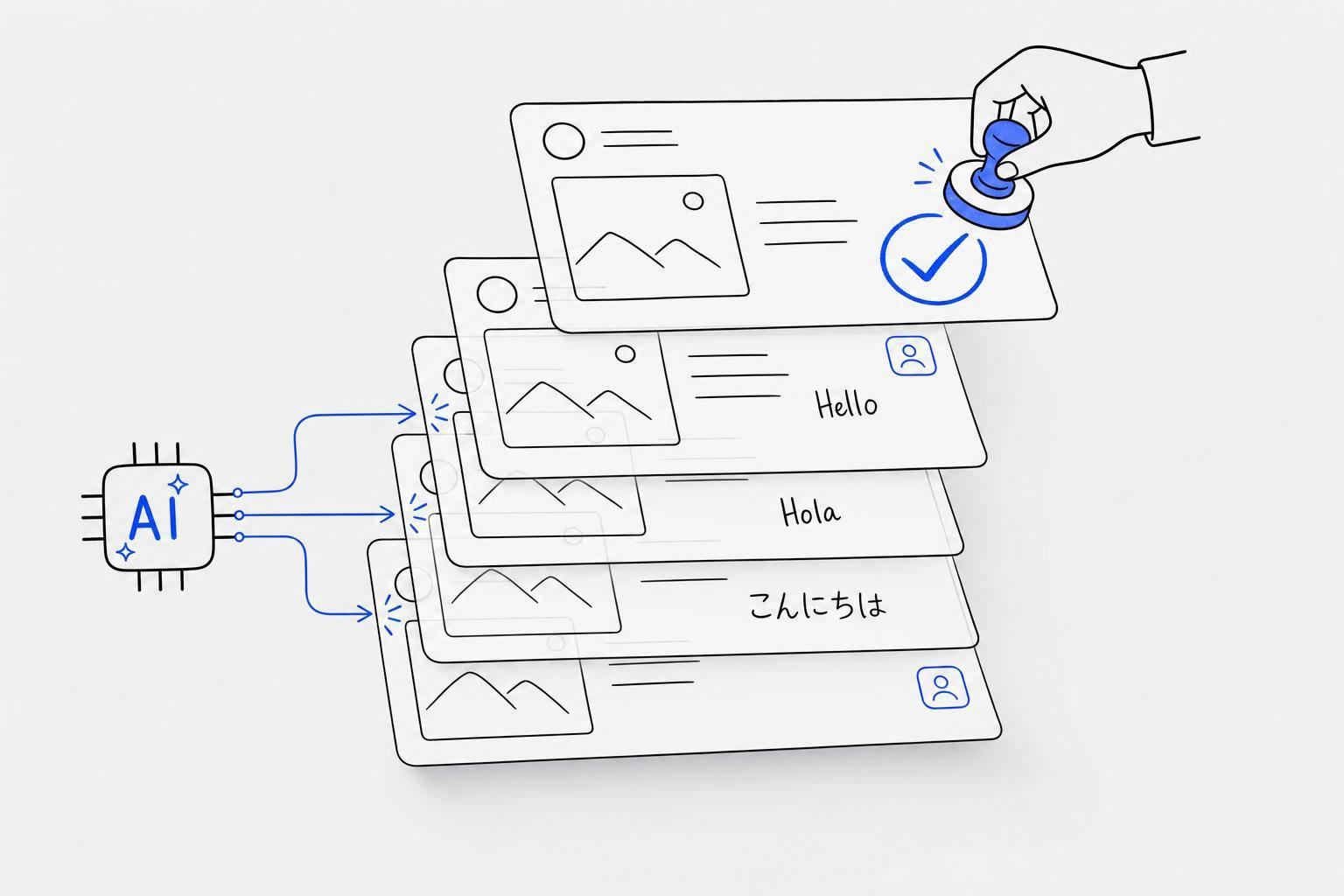
U.S. teams often need social content that speaks to different language groups. AI can produce multilingual content at scale, but volume alone isn't enough. The output still has to fit the people reading it.
Here's the key difference: translation swaps words from one language to another. Localization changes tone, context, and platform cues so the message feels right for that audience. If you skip that step, the post may be accurate but still feel off. That's why a human review step still matters before any localized content goes live.
The same idea carries over to format shifts too.
One idea turned into posts, carousels, threads, and short-form video scripts
Language isn't the only challenge. Format is a big one too. Every platform has its own rhythm, length, and style. A LinkedIn post doesn't read like an X thread, and neither works like a short-form video script.
Start with the core message first. Then AI can reshape that idea for each platform without changing what it means. One idea can turn into:
- a LinkedIn post
- an Instagram carousel
- an X thread
- a short-form video script
That makes it much easier to stretch one good idea across multiple channels instead of starting from scratch every time.
How Draft AI fits these 2026 content trends
Draft AI puts this into practice across both translation and format expansion. Draft AI fits these needs well. Users can paste notes or record a voice message, then turn that input into posts, carousels, Reels scripts, and threads. It also supports multilingual translation, so one idea can be shaped for different U.S. audience segments.
What makes it different from a basic translation workflow is its brand-voice matching feature. Draft AI studies your existing posts and Reels to learn how you write. Then it applies that same voice to new content, including localized versions. That's how brand voice stays steady even when the language changes.
The swipeable idea cards add one more useful layer. Users can look through AI-generated content ideas with strong hooks, save the ones that fit, and come back to them later.
| Feature | Manual Workflow | AI-Assisted Workflow |
|---|---|---|
| Speed | Slower, manual production per platform | Minutes from idea to multi-platform drafts |
| Formats | Limited to 1–2 formats per idea | Posts, carousels, threads, and video scripts |
| Localization | Basic word-for-word translation | Cultural adaptation and localized hooks |
| Reach | Limited to primary language audience | Expanded reach across U.S. multilingual segments |
Conclusion: What teams should focus on when using AI for social media in 2026
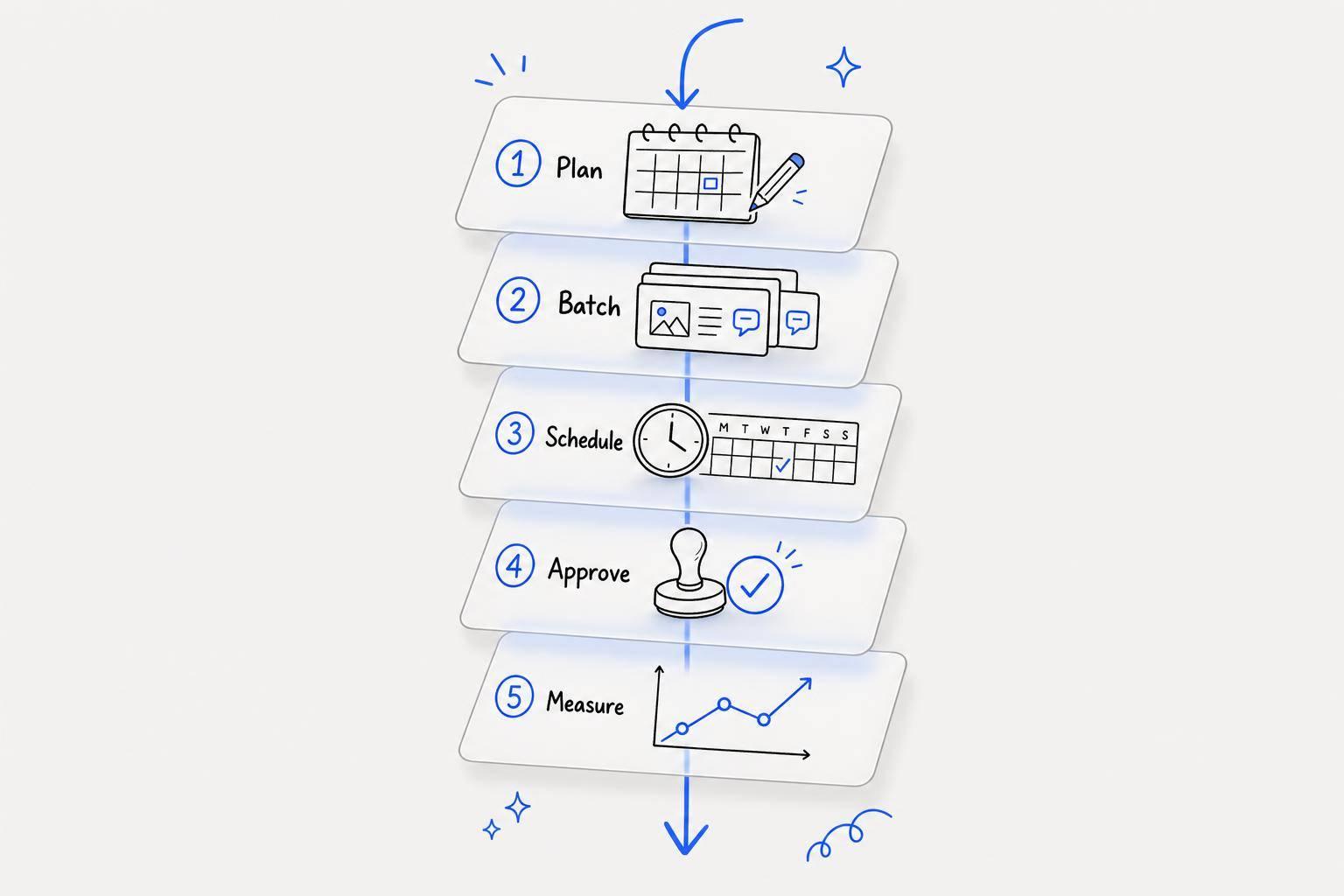
The main rule is simple: use AI in three layers - automate, personalize, then scale formats. When one idea can move across languages and content types, the next job is tight execution. Start with one workflow your team can repeat with confidence before you stack on more layers.
Once automation is in place, personalization becomes the biggest driver of performance. Personalization and timing optimization can lift engagement, but only if your brand voice is clear from the start. Write down your tone, vocabulary, values, and what to avoid. Then use that guidance in every AI session. If you skip that step, the output can drift into bland, generic copy.
Human review should stay in the process every time. It needs to be the final gate for accuracy, brand fit, and cultural sensitivity. AI can help teams produce more, but people still protect the quality.
Use AI where it saves time or improves results. Stop using it when the review work starts costing more than the gain. In 2026, AI should make execution faster. Humans should own strategy, judgment, and final approval. That balance is the real edge in 2026.
FAQs
How do I start using AI for social media?
Start by looking at your current workflow and finding the slow spots. Maybe it’s writing captions, coming up with post ideas, or turning rough notes into something publishable. Those are usually the places where AI can save the most time.
A tool like Draft AI can take raw data, voice memos, or basic business details and turn them into on-brand content. You can use it to draft scripts, build carousels, and create versions for different platforms.
The key is simple: let AI do the heavy lifting on execution, while you stay in charge of strategy, tone, and brand identity.
How can I keep AI content on-brand?
Use tools like Draft AI to keep your brand guidelines inside the system instead of depending only on manual prompts.
To keep your brand voice up to date, refresh your style profiles with recent samples and clear rules for tone, vocabulary, and sentence structure. That gives the system a much better sense of how you sound. It also helps cut down on generic content and keeps your messaging consistent across social platforms.
When should humans review AI-generated posts?
Human review needs to happen before any AI-generated post goes live.
AI can speed up ideation, drafting, and resizing. That part is useful. But the editorial layer still needs a person behind it. That’s how you protect brand integrity and avoid posts that feel generic or get facts wrong.
A final human check helps make sure the post sounds like your brand, not like a bland template. It also adds nuance and original insight while keeping the piece factually accurate, SEO-friendly, and consistent in tone.