How AI Adapts Content for Instagram vs. LinkedIn
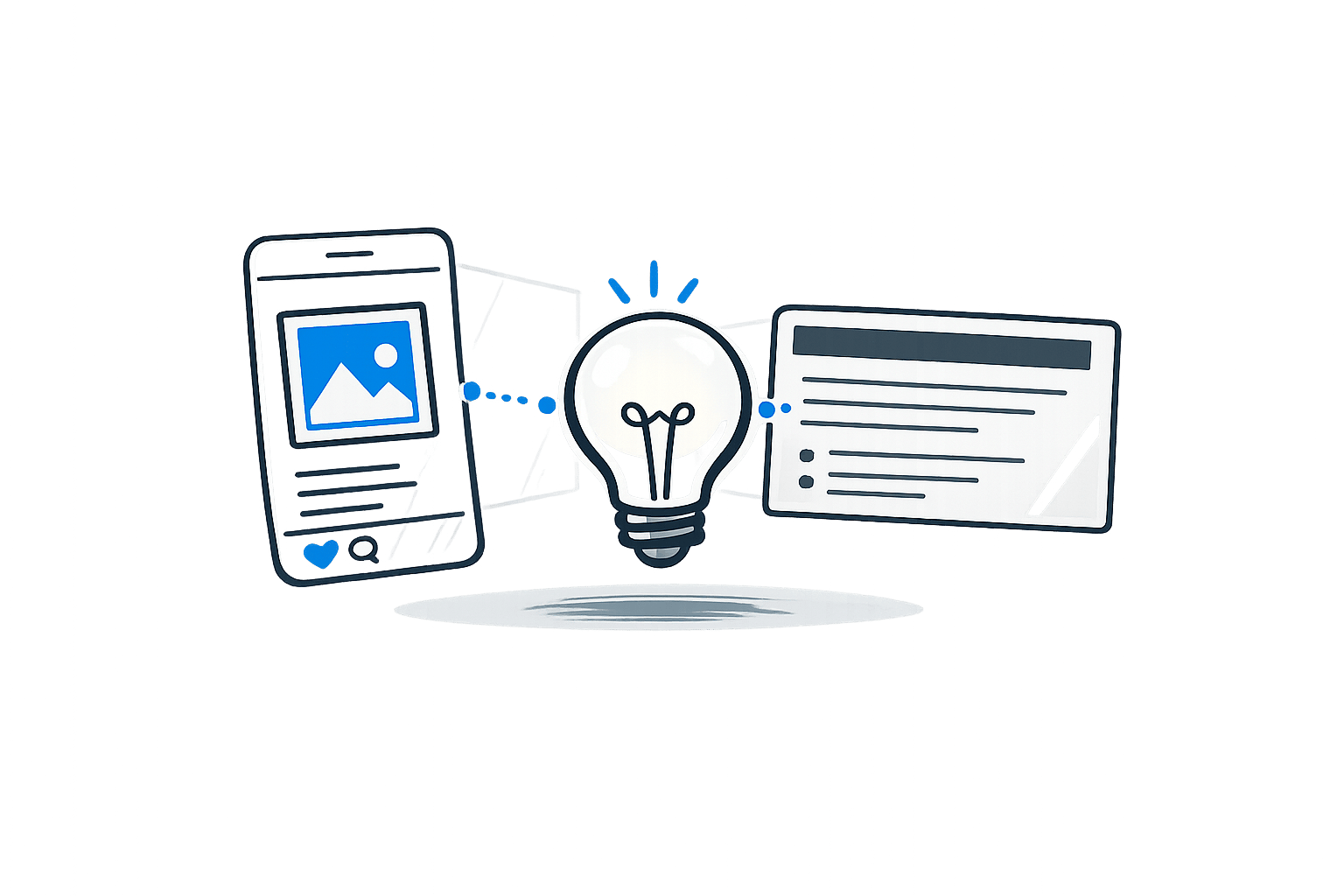
When sharing content on Instagram and LinkedIn, using the same approach can hurt engagement. These platforms serve different purposes, and their audiences expect unique content styles. Instagram thrives on visuals and emotional storytelling, while LinkedIn values professional, data-driven insights. AI tools simplify this process by reshaping a single idea to fit each platform’s specific needs, saving time and improving results.
Key Takeaways:
- Instagram: Focus on eye-catching visuals, short captions (125–150 characters), and emotional hooks. Carousel posts perform best with a 6.9% engagement rate.
- LinkedIn: Prioritize long-form, professional content with data and insights. Posts over 1,200 words and document formats (PDFs) perform well, with up to 37% engagement rates.
- AI Tools: Automate content adjustments, like resizing images for Instagram or refining tone for LinkedIn, cutting content creation time by 60–80%.
Quick Comparison:
| Feature | ||
|---|---|---|
| Tone | Conversational, Emotional | Professional, Authoritative |
| Visuals | High-quality, vertical images | Clean, data-focused visuals |
| Content Length | Short captions (125 visible chars) | In-depth posts (up to 3,000 chars) |
| Engagement Metric | Likes, Saves, Shares | Comments, Reactions, Networking |
| Best Format | Carousels (6.9% engagement rate) | PDFs (37% engagement rate) |
Tailoring content for each platform ensures your message resonates with the right audience. AI tools like Draft AI make this process faster and easier, helping you deliver effective posts on both platforms.
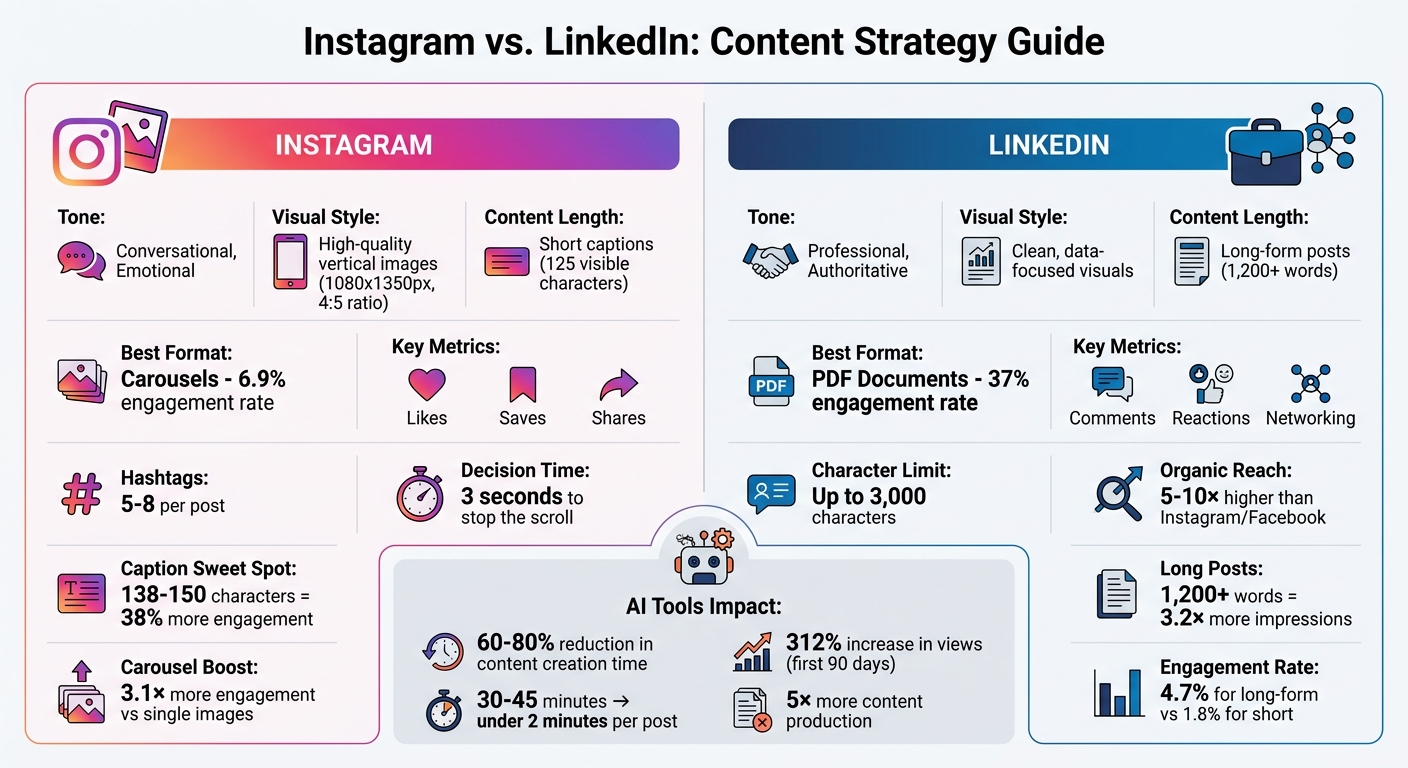
Instagram vs LinkedIn Content Strategy Comparison
What Instagram Content Needs
Instagram users make decisions in just three seconds. This mobile-first platform thrives on visually compelling, immediate, and vertically optimized content - very different from LinkedIn's professional tone.
Visual and Aesthetic Focus
Instagram is all about visuals. Users expect high-quality images, cohesive color schemes, and polished layouts that grab attention instantly. Vertical formats, particularly 1080x1350px (4:5 ratio), dominate because they take up more screen space than square images. Carousel templates shine here - they boast a median engagement rate of 6.9% and generate 3.1× more engagement compared to single-image posts.
"On Instagram, you have three seconds to stop the scroll. Your first carousel slide isn't just important - it's everything."
– Social Media Examiner
AI tools allow you to create social media posts in minutes. They can remove backgrounds, create professional layouts, and resize images to fit Instagram's specifications. The platform's "second chance" algorithm, which resurfaces carousel posts to users who initially skipped them, also boosts engagement. For optimal readability, use fonts that are at least 24pt, and keep each carousel slide focused on a single idea to avoid overwhelming viewers.
Once the visuals are set, the caption needs to match their impact.
Short and Emotionally Engaging Captions
Captions on Instagram need to hook readers immediately. The first 125 characters are crucial for driving engagement. Keeping captions concise - ideally between 138 and 150 characters - can increase engagement by up to 38%. Including a question in the opening line can also boost comment rates by 22%.
"A caption is the difference between a scroll and a stop. Getting someone to pause on your post in a feed moving at 150 milliseconds per frame requires a first line that earns attention."
– Priya Patel, Instagram & Reels Strategist
AI tools can help craft multiple caption styles - whether educational, playful, or story-driven - to find the tone that resonates most. However, it's essential to humanize AI-generated text. For example, replace generic phrases like "Let us know your thoughts" with specific calls to action like "Which slide stood out most to you?" Structured AI prompts have been shown to boost engagement by 35% to 50% compared to generic inputs.
After nailing the visuals and captions, hashtags are the next step in increasing content visibility.
Hashtags and Trends
Hashtags play a dual role on Instagram: they help users find your content and signal the algorithm about your post's topic. In 2026, the sweet spot for hashtags is 5–8 per post, far fewer than the 30-tag maximum. Overusing or repeating hashtags can lead to a shadowban, which limits your post's reach.
AI tools can rotate hashtags dynamically, keeping them aligned with trending topics and avoiding spam-like patterns. Instagram's algorithm has shifted its focus from engagement-based metrics to signal-quality metrics, like watch-through rates, saves, and "sends per reach". Additionally, AI can suggest trending topics tailored to specific niches, helping you align your posts with what your audience cares about. A mix of niche-specific and trending hashtags often outperforms broader, high-competition tags, making this blended approach key for maximizing reach.
sbb-itb-9f5fe42
What LinkedIn Content Needs
LinkedIn is where professionals go for growth and industry insights. With over 1 billion users, the platform values content that showcases expertise and delivers real value. Unlike platforms designed for quick, surface-level consumption, LinkedIn users take their time, making it a space where thoughtful, in-depth content thrives. Here’s what makes LinkedIn content stand out.
Authority and Expertise
The most effective LinkedIn posts strike a balance between authority and relatability. They combine professional credibility with a touch of vulnerability. This approach builds trust by showing expertise while being open about challenges or uncertainties. Think of it as aiming for a tone that’s about 70% formal - enough to establish your knowledge, but conversational enough to spark engagement.
"The highest-performing LinkedIn content combines professional credibility ('I have done this for ten years') with honest admission of failure or uncertainty ('and I was wrong about this for most of that time')."
– Atom Writer Blog
Specificity is key. Generic statements don’t stand out, but concrete details do. For instance, instead of saying, "we saw great results", say, "our engagement rate increased from 2.4% to 6.8% in three months." LinkedIn’s algorithm, which prioritizes “creator authenticity,” penalizes posts that rely on generic or formulaic AI phrasing. Avoid overused terms like "delve", "navigate", or "unlock".
To keep readers hooked, structure your posts with a simple flow: Hook → Tension → Concrete Insight. The first two lines are crucial - grab attention with a bold statement, an unexpected statistic, or a personal revelation.
Data-Driven and Long-Form Content
Data and depth drive LinkedIn engagement. Posts over 1,200 words generate 3.2× more impressions and a 4.7% engagement rate compared to 1.8% for shorter posts. Why? Because LinkedIn’s algorithm rewards dwell time - the longer someone spends reading your post, the better it performs.
"Dwell time is the #1 signal... A post that makes people stop and read for 15+ seconds gets a massive algorithmic boost over a post that gets a quick scroll."
– Autoadify Team
Back up your points with specific data. For example, instead of saying "engagement matters", clarify with, "comments are weighted 3:1 over reactions in the LinkedIn algorithm". Posts with clear sections - five or more - are saved 2.1× more often, extending their relevance from a few days to weeks.
Want the highest engagement? Try LinkedIn documents (PDF carousels). These achieve a 37% engagement rate, making them the platform’s top-performing format. They’re especially effective for guides, frameworks, and data visualizations. Stick to 6–10 pages to meet professional expectations.
Networking and Professional Branding
LinkedIn content isn’t just about insights - it’s about building connections and reflecting your brand. The platform’s algorithm uses interest-based distribution, categorizing your content by topic and showing it to users who care about those subjects. Consistent, niche-focused posts create an "expertise signal", helping your content reach the right audience.
Organic reach on LinkedIn is 5–10× higher than on platforms like Instagram or Facebook. Thoughtful comments, not just likes, are the true measure of success. To maximize engagement, respond to comments within the first 60–90 minutes of posting.
Follow the 80/20 rule: focus 80% on providing value and 20% on promoting your brand or services. Avoid putting external links in the post body - this can reduce reach by 30%. Instead, drop links in the first comment after publishing. Timing also matters; post during peak hours like Tuesday to Thursday mornings, lunch breaks, or early evenings.
Key Differences Between Instagram and LinkedIn Content
Instagram leans toward entertainment and lifestyle content, while LinkedIn focuses on professional insights. Each platform caters to unique audience expectations. Instagram thrives on conversational and relatable language, while LinkedIn demands a professional and authoritative tone to establish credibility. For instance, Instagram hooks might say, "This changed everything", whereas LinkedIn hooks often highlight value, like "Here is what 500 marketers revealed".
"The most successful content marketers don't chase platforms - they follow their audience's natural habitat and adapt their message accordingly." – Content Marketing Institute
On Instagram, eye-catching visuals and minimal text are essential for grabbing attention quickly. LinkedIn, on the other hand, supports detailed, data-driven posts that users are willing to spend more time reading. While Instagram encourages "quick wins" (e.g., one point per slide), LinkedIn rewards in-depth strategies, frameworks, and professional storytelling.
Content Comparison Table
| Feature | ||
|---|---|---|
| Primary Tone | Conversational, Emotional, Relatable | Professional, Authoritative, Expert |
| Visual Approach | Aesthetic, Lifestyle, High-Impact | Clean, Data-Driven, Functional |
| Content Focus | Entertainment & Inspiration | Education & Industry Insights |
| Caption Length | 2,200 characters (125 visible) | 3,000 (Personal) / 1,300 (Company) |
| Links | No clickable links in captions | Clickable hyperlinks allowed in text |
| Format Preference | 1:1 Square or 4:5 Vertical | PDF Documents (Square or Landscape) |
| Engagement Metric | Likes, Saves, Shares | Comments, Reactions, Networking |
Instagram captions cut off after 125 characters, requiring users to click "more" to see the rest, while LinkedIn allows up to 3,000 characters for personal posts. Additionally, Instagram doesn't support clickable links in organic captions, forcing users to rely on "link in bio." In contrast, LinkedIn enables direct hyperlinks within the post text. To maximize this advantage, many professionals use LinkedIn AI scheduling tools to manage their posting frequency and engagement.
To succeed on both platforms, you might need to turn a detailed LinkedIn guide into a snappy Instagram list or expand an Instagram post into a LinkedIn piece with professional insights and data.
Recognizing these differences is key to understanding how automated content creation tools adapt content for each platform. By adjusting tone, format, and style, these tools help optimize content for Instagram's immediacy and LinkedIn's depth.
How Draft AI Adapts Content for Each Platform
Draft AI takes the guesswork out of tailoring content for different platforms by fine-tuning tone, format, and structure. Whether it’s transforming a message into an eye-catching Instagram carousel or a detailed LinkedIn article, the tool ensures your content fits seamlessly without needing manual rewrites.
Custom Carousels and Visuals for Instagram
Instagram thrives on visuals, and Draft AI knows how to make them pop. The tool automatically resizes images to 1,080px wide in 1:1 (square) and 4:5 (vertical) ratios, ensuring they look perfect on mobile screens without awkward cropping. It organizes carousels into engaging formats like "Before-and-After" sequences or "Step-by-Step Tutorials", with the first slide designed to grab attention in under three seconds using bold visuals and compelling hooks.
Instagram captions are tricky since only the first 125 characters are visible before users need to tap "more." Draft AI addresses this by front-loading captions with emotional triggers to hook readers immediately. Plus, with brand kit integration, it keeps your color palette and typography consistent across slides. Fonts are kept large (minimum 24pt) and text is minimal, ensuring everything is easy to read on mobile.
Professional Text Posts and Articles for LinkedIn
When it comes to LinkedIn, Draft AI shifts gears to create polished, long-form posts that make the most of the platform's 3,000-character limit. It incorporates data-driven insights, industry-specific language, and a professional tone to help you build credibility among peers and industry leaders.
The tool’s one-click tone adjustment refines drafts to sound more professional or concise. It can also transform content from blogs, newsletters, or videos into LinkedIn-ready posts, saving you time. Instead of spending 30–45 minutes polishing a post, users can finalize it in under 2 minutes. Draft AI even suggests timely topics based on trending industry conversations, helping users stay relevant. Active users have reported a 312% increase in views over their first 90 days, with 90% posting consistency thanks to smart scheduling features.
AI-Driven Personal Writing Styles
Draft AI doesn’t just adapt content formats - it also customizes tone to match your unique writing style. By analyzing your past posts and Reels, the tool ensures every piece of content sounds like you. For Instagram, it leans on conversational storytelling with prompts like "wait until slide 7." On LinkedIn, it focuses on delivering clear value propositions and professional insights.
For example, in September 2024, a B2B tech company used this feature to turn complex, data-heavy content into LinkedIn posts while creating simplified, visually engaging Instagram versions. This strategy led to a 200% jump in LinkedIn engagement and a 150% growth in Instagram followers. It’s a clear reminder that tailoring content to each platform can dramatically improve results.
Draft AI also respects the technical nuances of each platform. It handles LinkedIn’s clickable links and Instagram’s "link in bio" limitation with ease, ensuring your content is always optimized for its audience. This approach highlights how platform-specific strategies are essential for maximizing engagement and visibility.
Benefits of Platform-Specific AI Content
Platform-specific AI content isn't just about tweaking a message - it’s about crafting content that resonates deeply with each platform's unique audience. By aligning your message with Instagram’s visual appeal or LinkedIn’s professional tone, you can achieve results that generic content simply can't deliver. This tailored approach shows its impact in engagement, brand consistency, and efficiency.
Better Engagement and Reach
Content tailored to a platform’s unique style consistently outperforms generic posts. Why? Because it aligns with the expectations of the audience. For example, LinkedIn rewards thoughtful, in-depth posts with higher engagement, while Instagram thrives on quick, visually striking content that feels genuine. By optimizing your content for each platform’s specific vibe, you’re not just showing up - you’re standing out. This approach ensures your content lands where it matters most: in front of an engaged audience.
Consistency Across Platforms
Maintaining a unified brand voice across multiple platforms can feel like a juggling act. That’s where tools like Draft AI come in. They help ensure your tone and message stay consistent, no matter the platform. As the Atom Writer Blog puts it:
"The brand that sounds like the same trusted voice everywhere - knowledgeable on LinkedIn, sharp on Twitter/X, energetic on TikTok - builds recognition and trust that the inconsistent brand simply cannot match."
Consistency isn’t just about aesthetics - it’s about results. Businesses with consistent branding report revenue growth of 10–20%. However, even though 85% of companies have brand guidelines, only a fraction (25–30%) enforce them. AI bridges this gap by embedding your brand’s voice into every post, while also adapting the tone, length, and style to fit each platform’s requirements.
Time Savings and Scalability
For busy professionals, time is always in short supply. Draft AI tackles this head-on. Instead of spending 30–45 minutes perfecting a single post, users can finalize content in under 2 minutes. Its Smart Scheduler ensures 90% posting consistency, keeping your brand visible even when your schedule is packed. By repurposing content from blogs, YouTube, or newsletters into platform-ready formats, users report producing five times more content.
Take it from Prasanna Wadgaonkar, Senior Quality Assurance Engineer, who shared:
"Writing posts in more professional ways to compete with industry experts was a big challenge. With Draft AI, I absolutely tackled it and got more post impressions than usual."
Conclusion
Crafting content that resonates on Instagram and LinkedIn requires more than simply reposting the same material across platforms. Instagram thrives on visual storytelling and emotional appeal, while LinkedIn rewards content rich in professional insights and backed by data. With 5.66 billion active social media users navigating an average of seven platforms each month, tailoring your approach to each platform's unique strengths has never been more important. These differences directly impact engagement outcomes.
For example, LinkedIn document posts boast a 6.6% engagement rate, while external links see their reach drop by 60%. On Instagram, static images currently outperform Reels, with engagement rates of 6.2% compared to 3.5%. These numbers highlight a critical truth: understanding and leveraging platform-specific behaviors can determine whether your content gets noticed or ignored. As Ty Heath, Director of Market Engagement at LinkedIn, explains:
"The brand that is most easily remembered is the brand that gets bought".
Recognizing these distinctions is only half the battle - execution is the real challenge. This is where tools like Draft AI come into play, cutting down the time needed to create platform-optimized posts from 30–45 minutes to under two minutes. By fine-tuning tone, format, and structure for each platform, it ensures your message stays authentic while meeting platform expectations.
For 54% of marketers, resource limitations remain the biggest hurdle to creating tailored content. The answer isn’t necessarily more staff - it’s smarter tools that adapt to each platform’s unique demands. With tools like Draft AI, you can focus on your ideas while the technology handles the heavy lifting, helping you maintain a consistent and impactful brand voice across platforms. Following a social media content creation checklist can further streamline this process.
FAQs
How do I turn one idea into both an Instagram carousel and a LinkedIn post?
When sharing the same idea on Instagram and LinkedIn, it’s all about playing to each platform’s strengths.
For Instagram, go for bold visuals and emotional storytelling. Use up to 10 visually appealing slides to grab attention and connect with your audience on a more personal level. Think of it as creating a mini visual journey.
For LinkedIn, focus on professional insights. Your content can be more text-heavy, offering detailed explanations or actionable advice. This approach appeals to a more business-oriented audience looking for value and expertise.
A great tool to make this process easier is Draft AI. It helps you quickly create drafts that fit each platform’s style, saving time while ensuring your message resonates with the unique preferences of both audiences.
What should I change first: visuals, caption length, or tone?
To connect effectively with your audience, start by nailing the tone for each platform. Instagram calls for a laid-back, lifestyle vibe, while LinkedIn requires a more polished, professional tone tailored to industry conversations. Once you've got the tone right, fine-tune your visuals to fit platform standards - think square images for Instagram and landscape formats for LinkedIn. Finally, tweak your captions to match the engagement style of each platform; shorter, snappy captions work on Instagram, while LinkedIn often performs better with more detailed, informative text.
How can Draft AI keep my voice consistent across Instagram and LinkedIn?
Draft AI helps you maintain a consistent voice across Instagram and LinkedIn by studying your writing style - everything from tone to word choice and sentence structure. By training the AI with your previous posts or voice samples, it gets a better grasp of how you communicate. Tools like custom instructions and Style Definition Documents ensure your tone stays aligned with each platform’s audience. This means you can save time while keeping your brand's personality intact.